For heavy-duty lifting, an electric wire rope hoist is often your best choice for a material handling system.
This guide explains when a wire rope electric hoist is a better choice than a chain hoist, and then breaks down 7 key parameters you should evaluate before purchasing. The goal is to help engineering, maintenance, and procurement teams reduce selection risk and match hoist performance to real site conditions.
When to Prioritize a Wire Rope Electric Hoist?
Wire Rope Hoist vs. Chain Hoists
Compared with chain hoists, wire rope hoists are designed for higher capacities, higher lifting heights, and more frequent heavy-duty cycles.
- Chain hoists are commonly applied in the 0.5 to 10 ton range and in some cases up to about 30 to 50 tons, but they are usually recommended for lighter or intermittent duty.
- Wire rope hoists, in contrast, are frequently selected from around 5tons upwards and can cover 50 tons and well beyond in engineered systems.
Industry practice often uses “above 5 tons with high–frequency heavy–duty operation” as a practical dividing line where a wire hoist becomes the safer and more economical choice over its service life. However, the final decision must consider the full duty profile, lifting height, required positioning accuracy, environment, and life cycle cost, not just rated capacity.
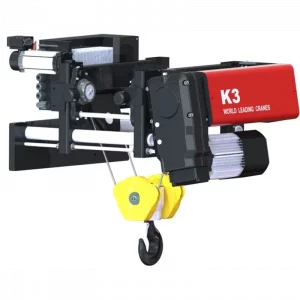
WORLDHOISTS Electric Wire Rope Hoist K3
Structural Characteristics of Wire Ropes
Further Exploration: An In-Depth Look at the Structure of an Electric Hoist
Wire ropes are composed of many steel wires twisted into strands and then laid helically around a core, which may be fiber or steel. This structure offers a high strength-to-weight ratio, flexibility for reeving over sheaves, and good fatigue resistance under cyclic loading when specified and maintained correctly.
Galvanized or specially coated ropes can further improve corrosion resistance in harsh environments.
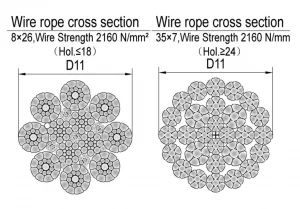
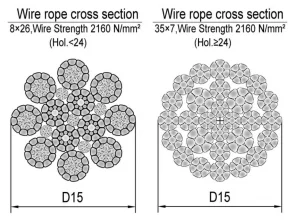
Wire rope structure diagrams (two commonly used sizes) for WORLDHOISTS hoists
5 Core Advantages of Electric Wire Rope Hoists
1. Heavy load capacity
Wire rope electric hoistsare engineered for very heavy loads, with common catalog capacities up to 50 tons and custom systems going higher. This makes them suitable for steel mills, shipyards, mining, and heavy machinery manufacturing, where large components must be lifted frequently.
2. Large lifting height
The rope drum design allows long lengths of wire rope to be wound, enabling large lifting heights without compromising stability. This is important in high-bay warehouses, prefabrication plants, and construction projects that require multi-level lifting. The maximum lift height of modern models can reach 90 meters.
3. High precision positioning
Wire rope hoists can be equipped with variable frequency drives and fine control to deliver smooth acceleration and deceleration, which improves hook positioning accuracy. The reeving system also helps maintain vertical hook travel for the precise placement of molds, dies, or process equipment.
4. Long–duration suspended holding
High-performance braking systems and robust gearboxes allow wire hoists to hold heavy loads suspended for longer periods within their duty rating. This is useful for operations such as assembly, welding, or alignment, where components must be held steady while work is performed.
5. Capability in extreme environments
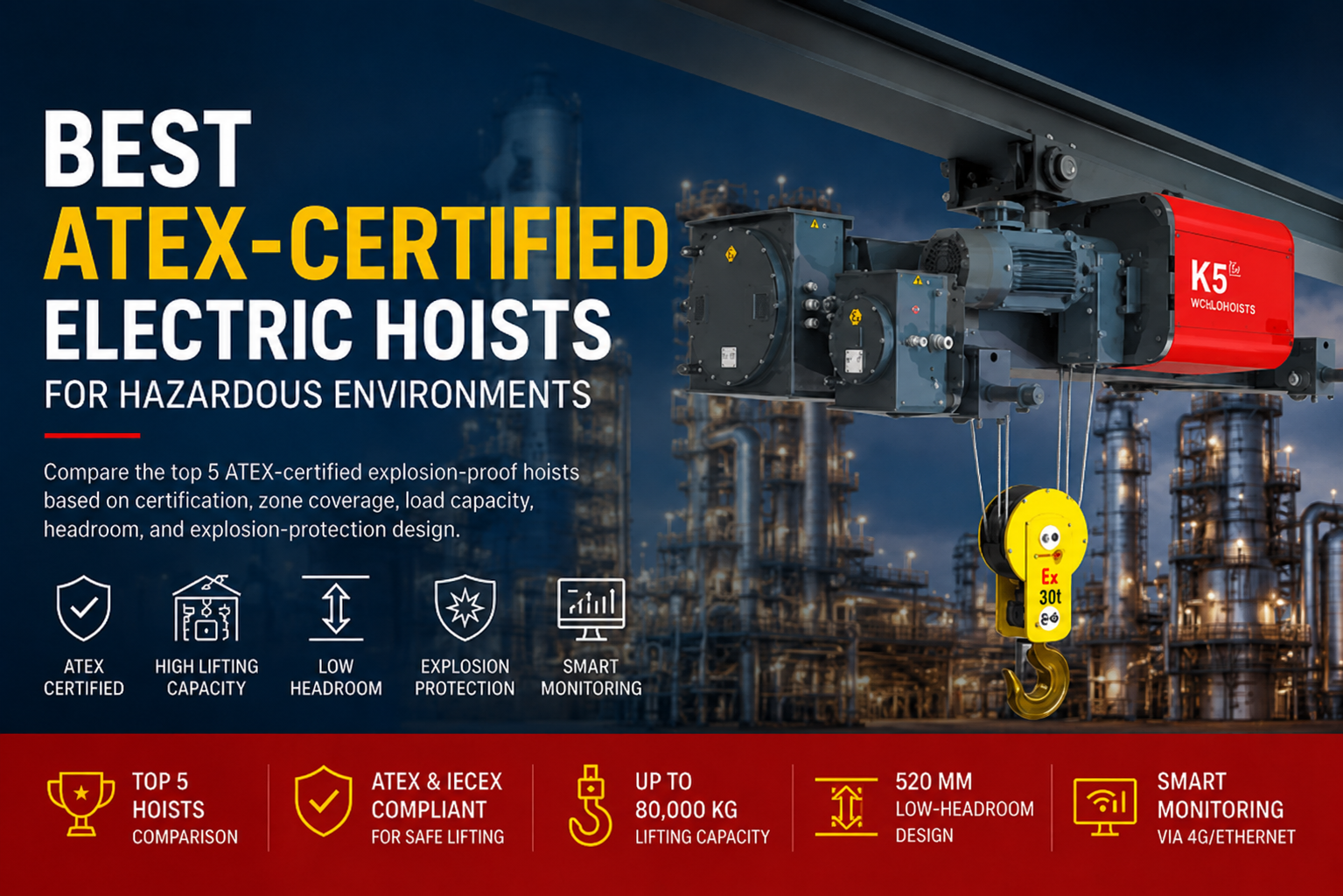
Electric wire rope hoists are commonly used for hot metal handling, outdoor yards, explosion-prone areas, and corrosive environments, provided the correct design and protection are specified. Options include thermal protection, explosion-proof motors, special paints, galvanized or stainless wire ropes, and dust or moisture-resistant enclosures.
Continue reading: How to Choose an Explosion-Proof Hoist? 6 Key Factors You Can’t Ignore
7 Key Parameters to Focus on When Purchasing
This section explains the 7 main decision variables, why they matter, and how to choose realistically.
1. Capacity
Capacity is the maximum safe working load the hoist can lift, usually expressed in tons. Wire rope hoists are typically selected for heavier or more frequent duty applications, often starting from around 5 tons upwards, where chain hoists may no longer provide sufficient safety margin or life.
How to choose:
• Calculate the maximum load, including hooks, lifting beams, and devices below the hook.
• Apply appropriate safety factors based on standards and local regulations.
• For frequently repeated near-full-load lifts, consider selecting a higher-capacity hoist with a matching duty class to improve service life.
2. Lifting Height and Headroom
Lifting height is the vertical distance the hook must travel between its lowest and highest working positions. Headroom is the vertical distance from the underside of the runway beam to the hook in its uppermost position; the smaller the headroom, the greater the effective lifting height available under a given building clearance.
For example, low headroom models from WORLDHOISTS use compact hoist trolleys and drum arrangements to maximize hook approach and minimize structural height.
How to choose:
• Measure actual floor to beam or floor to rail height.
• Define the minimum hook height required above the floor for load clearance.
• Select a hoist whose headroom allows the hook to reach the required height while remaining within structural limits.
3. Duty Class (FEM and ISO)
Duty class combines the frequency of use and the load spectrum, reflecting the hoist’s true operational intensity more accurately than capacity alone.
Common international standards include:
ISO 4301: M1 to M8
FEM 9.511: 1 Bm, 1 Am, 2m, 3m, 4m, 5m
The duty class is primarily determined by two factors:
Load Spectrum Factor: the distribution of loads handled (light vs. heavy)
Number of Operating Cycles: how frequently the hoist is used
Common Duty Class Mapping (Low to High)
FEM Class | ISO Class | Typical Application |
1Bm | M3 | Light duty, infrequent use; maintenance, installation workshops |
1Am | M4 | Medium duty, moderate frequency; machine shops, assembly areas |
2m | M5 | Heavy-duty, frequent use; warehouses, production lines |
3m | M6 | Very heavy-duty, high frequency; steel mills, foundries |
4m | M7 | Extremely heavy-duty, near continuous operation; large casting facilities |
5m | M8 | Continuous duty, 24/7 operation; nuclear facilities, waste-to-energy plants |
Selection Tip: Do not select based solely on capacity. If the hoist will be used frequently (e.g., dozens of cycles per day), a higher duty class is essential—even if the loads are relatively light. Selecting an insufficient duty class will lead to overheating and premature failure of motors and mechanical components.
4. Lifting Speed and Travelling Speed
Lifting speed is the rate at which the hook moves vertically, while travelling speed is the speed of the hoist or crane trolley along the rail. Faster speeds improve productivity but can increase load swing and require more skilled operators and better controls.
How to choose:
• For precision assembly or fragile loads, consider lower speeds or dual-speed/variable-frequency drives to allow a slow approach.
• For long travel distances or high-throughput lines, higher travel speeds with smooth acceleration can reduce cycle times.
• Always verify that the speed profile, braking system, and control mode are compatible with the duty class and operator skill level.
WORLDHOISTS offers electric wire rope hoists with intelligent control options, including variable-speed drives for both lifting and travelling, to improve productivity and positioning accuracy.
5. Power Supply and Electrical Configuration
Many industrial hoists are supplied for three-phase power, such as 380-480 V at 50 or 60 Hz.
Other electrical configuration points:
• Control voltage and protection: Low-voltage pendant control for operator safety, overload protection, and emergency stop circuits.
• Motor protection: Thermal overload relays and protection class suited to the ambient environment and dust or moisture levels.
• Integration: Requirement for radio remote control, limit switches, and interlocks with plant safety systems.
6. Operating environment and special requirements
The operating environment is a critical factor in selecting a wire rope electric hoist. Key aspects include:
• Ambient temperature
High-temperature applications,such as foundries, require hoists with heat-resistant components, a suitable motor insulation class, and protective covers. Low-temperature environments may need special lubricants and enclosures to maintain performance.
• Explosion risk
For chemical plants or dust-laden environments, explosion-proofor spark-resistant hoists should be specified, in accordance with applicable ATEX or local standards.
• Corrosive conditions
Coastal yards, wastewater plants, and some process industries require corrosion-resistant finishes, galvanized or stainless wire ropes, and sealed bearings.
• Cleanliness and special industries
Clean rooms, nuclear facilities, and food plants may require low-noise operation, special coatings, and easy-to-clean surfaces.
• Installation space
Restricted spaces may require low headroom or compact trolley configurations to achieve the required hook path in tight areas.
7. Rail Compatibility
Rail compatibility covers the mechanical interface between the hoist trolley and the supporting beam or crane bridge. The wheel profile, wheel load, and flange width must match the rail type, such as standard I beams or special crane rails.
Selection steps:
• Confirm beam or rail size, type, and span.
• Check the hoist trolley adjustment range and wheel load to ensure safe operation and acceptable structural deflection.
• Consider future upgrades; if higher-capacity cranes are added, plan beam and rail sizes accordingly.
WORLDHOISTS Wire Rope Hoist Solutions
WORLDHOISTS is an electric wire rope hoist manufacturer with over 20 years of engineering experience and more than 400 patents, producing more than 10,000 units annually for customers around the world. The K Series and H Series cover capacities from 0.8t to 80t, with configurations for standard industrial, explosion-proof, and specialized uses (e.g., metallurgical, clean room, nuclear environments, and Marine). A skilled team of installation and maintenance professionals provides commissioning, training, and continuous after-sales support to customers.
Ready to specify the right wire rope hoist for your project? Visit WORLDHOISTS hoist products or contact our team directly for a customized quotation.