Industrial winches are designed to handle demanding tasks such as equipment positioning, material pulling, and auxiliary lifting in factories, ports, and mining sites.
Unlike standard off-road or commercial winches, industrial-grade units are built for continuous, high-intensity operation.
This article explores industrial winches’ working principles, key components, and selection criteria to help you choose the right equipment for your application.
What Is an Industrial Winch?
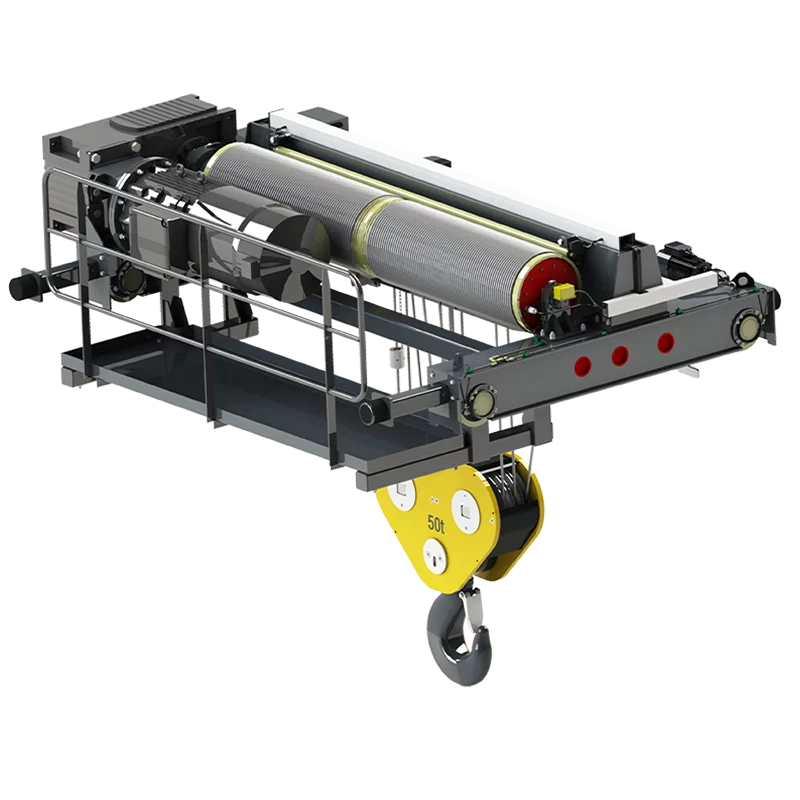
An industrial winch is a mechanical device that pulls, lifts, or tensions heavy loads by winding rope or wire rope around a rotating drum. It is fundamentally engineered for continuous heavy-duty applications in industries (e.g., construction, maritime, mining, and manufacturing).
Industrial winches differ significantly from light-duty commercial or off-road winches. While off-road winches are designed for intermittent vehicle recovery, industrial winches incorporate heavier-duty components, higher duty cycles, and more comprehensive safety systems to support sustained operation. They typically comply with strict safety standards such as ASME B30.7, which governs construction, installation, operation, inspection, and maintenance.
How Does an Industrial Winch Work?
Working Principle
A winch converts motor power into a linear pulling force. The motor drives the drum to rotate, winding or unwinding the rope. The pulling force is determined by torque divided by drum radius, and as the rope layers increase, the effective drum diameter grows, reducing the pulling force accordingly. Power requirements balance pulling force and line speed, with gear system efficiency factored into the calculation.
When used with pulley blocks, the pulling capacity of a winch can be multiplied. For example, using two sets of movable pulleys can increase pulling force up to four times, enabling the equipment to handle loads far beyond its rated baseline capacity.
Key Components
Component | Function | Key Features |
Power Unit | Drives the winch | Electric motors for clean, efficient environments; internal combustion engines for remote sites; hydraulic motors for continuous operation in harsh conditions |
Transmission | Reduces speed, increases torque | Planetary gearbox for high efficiency and compactness; chain or belt drives for alternative configurations |
Braking System | Safely holds the load | Spring-applied (fail-safe) brakes engage automatically when power is lost; dual-brake systems designed to meet redundancy requirements in standards such as ASME B30.7 |
Drum | Stores the rope | Size determines rope capacity; multiple layers reduce effective pulling force as the diameter increases |
Control System | Manages speed and direction | PLCs, slack rope detection sensors, and remote control options enhance operator safety |
Frame | Provides structural support | Rigid base absorbs operating stresses; flexible mounting helps eliminate internal stresses |
Main Types of Industrial Winches
By Power Source
Electric and hydraulic winches are the two dominant types in industrial applications.
Electric winches offer clean operation, easy installation, and high efficiency, making them suitable for factory and manufacturing environments.
Hydraulic winches excel in continuous heavy-duty applications such as maritime and mining operations, delivering consistent output without overheating concerns.
Type | Advantages | Best Applications |
Electric Winches | Clean operation, energy-efficient, easy to install | Factories, manufacturing, construction sites |
Hydraulic Winches | High duty cycle, rugged, smooth output | Maritime, mining, offshore operations |
WORLDHOISTS industrial electric winches feature a compact design that reduces overall height and weight, making them suitable for installations with limited space. Their modular structure and lightweight design provide flexible mounting options while maintaining heavy-load capacity.
By Number of Drums
Single-drum winches are used for conventional pulling and lifting tasks.
Multi-drum configurations handle complex operations. For example, dual-drum systems can maintain constant tension in skidding, towing, or mooring applications.
By Speed
Low-speed winches prioritize torque, making them ideal for heavy lifting and precise positioning.
High-speed winches are suited for applications requiring rapid payout and retrieval. Speed selection should match operational needs, noting that the actual pulling force decreases as the wire rope layers on the drum.
How to Choose the Right Industrial Winch
Step 1: Define Your Requirements
Calculate the maximum load and apply an appropriate safety factor.
For mooring or towing applications, a safety factor of 1.5 to 2 times the working load is a common baseline, while lifting applications typically require a higher design factor of 5:1. For pulling applications, a 3:1 safety factor is commonly used.
When determining total pulling requirements, consider rolling resistance, static load, surface conditions, and slope angles.
Step 2: Evaluate the Operating Environment
Assess the conditions in which the winch will operate.
Marine environments demand corrosion-resistant materials and protective coatings. Mining applications may require explosion-proof construction and specialized safety features.
Duty cycle is equally critical: electric winches are well-suited for intermittent operation, although certain industrial electric winch models with high-duty-cycle designs can also support continuous operation. Hydraulic or engine-driven winches are often preferred for sustained heavy-duty use.
Step 3: Prioritize Key Features
Give priority to the braking system, control interface, and rope storage capacity. Choose products that comply with recognized duty classifications such as FEM or ISO standards, which define design life and structural strength requirements.
Total cost of ownership considerations should include installation complexity, maintenance frequency, and expected service life.
Explore more: 7 Key Factors in Selecting Your Electric Wire Rope Hoist
Frequently Asked Questions(FAQs)
1. What capacity winch should I choose?
Sizing should be based on the maximum expected load, with an appropriate safety margin. For lifting applications, a standard design factor of 5:1 is typical. For pulling applications, a 3:1 safety factor is commonly used. Note that a winch provides maximum pulling force on the first rope layer; capacity decreases as additional layers build up.
Contact WORLDHOISTS for precise sizing assistance based on your specific application requirements.
2. How do I choose between electric, hydraulic, and pneumatic winches?
- Electric winches are an excellent choice where reliable power is available and clean, efficient operation is desired, offering lower initial cost and easier installation.
- Hydraulic winches excel in heavy-duty continuous applications, with superior durability and consistent output.
- Pneumatic (compressed air) winches provide spark-free operation, making them suitable for hazardous environments where electrical equipment poses a risk.
The final choice depends on available power sources, duty cycle requirements, and environmental conditions.
3. How often should wire rope be inspected or replaced?
Perform a visual inspection before each use, focusing on the rope segments that will be used during the day. For winches in regular service, a comprehensive inspection should be conducted at least monthly. Replace the wire rope if any of the following conditions are observed:
– Number of broken wires exceeds specified limits (typically 5 broken wires in one lay length)
– Diameter reduction of 10% or more due to wear
– Kinking, crushing, or birdcaging
– Corrosion or heat damage
For winches used in critical applications, an annual professional inspection by a qualified person is recommended. Always refer to the equipment manual and local safety regulations for specific inspection criteria.
4. What should I do if the winch suddenly stops working?
Start with basic checks: verify power supply, inspect control wiring connections, and ensure thermal overload protection has not tripped. Check for slack rope conditions that may have activated safety sensors. Verify that the brake engages and releases properly. If fault codes are available, review the control system’s error log. For complex issues, contact a qualified service technician for systematic diagnosis, and avoid operating the winch without fully understanding the cause to prevent safety risks.
5. What routine maintenance does an industrial winch require?
Daily: Visually inspect the wire rope, hook, and control functions.
Monthly: Test brake system performance, check fastener torque, and lubricate moving parts.
Quarterly: Inspect gearbox oil condition, verify seal integrity, and confirm drum alignment.
Annually: Conduct a comprehensive inspection in accordance with ASME B30.7 or applicable standards, performed by a qualified individual. Maintain detailed maintenance records to track component wear and repair history.
Conclusion
Industrial winches are essential tools for safe and efficient material handling in demanding environments. Understanding how they work, the key components that ensure reliable operation, and the factors that guide proper selection helps operators and procurement professionals make informed decisions.
WORLDHOISTS offers a range of products built to rigorous industrial standards. Our engineering team can help ensure you receive equipment matched to your specific operational needs.
Visit WORLDHOISTS to explore the right winch solution.