Modern factories, warehouses, and workshops demand more from their lifting equipment than raw power. Precision errors cost time. Unexpected failures cost lives. As industrial operations grow more complex, hoist equipment must now deliver real-time intelligence, built-in protection, and data-driven reliability — not just lift loads from point A to point B.
Driven by Industry 4.0, smart hoist technology is transforming traditional lifting systems by integrating intelligent monitoring, automation, and advanced safety functions. A modern smart hoist system enables more efficient operations, better equipment visibility, and improved reliability in demanding industrial environments.
The New Standard for Industrial Lifting
Manufacturing and logistics facilities worldwide are under pressure to increase throughput, improve workplace safety, and reduce unplanned downtime. These challenges are driving the adoption of advanced lifting solutions, where smart hoist technology is becoming a key factor in improving operational efficiency and reliability.
Take a company that adopted smart hoist equipment as an example: it reported a 50% reduction in positioning errors, a 35% decrease in downtime, and a 15% reduction in cycle time. Meanwhile, analysts predict that by 2030, 70% of overhead cranes in industrial settings will incorporate some form of automation or IoT — up from just 25% in 2025.
The Core 10 Technologies Behind Smart Hoist Equipment
Today’s advanced lifting crane systems are defined by three core capability clusters: Precision Control, Proactive Safety, and Intelligent Maintenance. Together, these technologies form the foundation of modern smart hoist technology, helping industrial lifting systems achieve higher efficiency, improved safety, and more reliable operation.
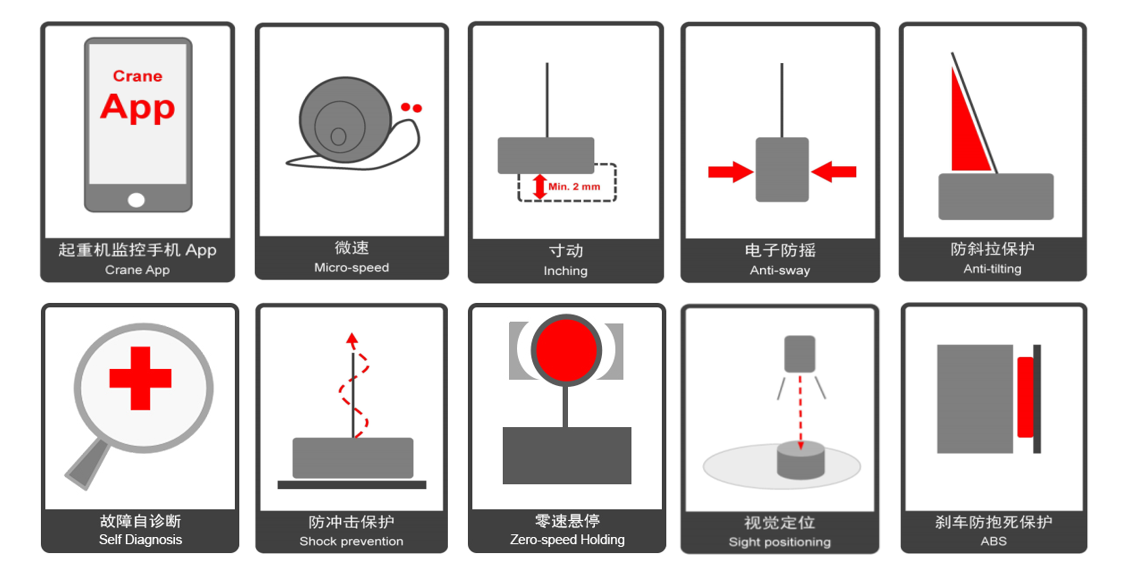
Here is how these technologies deliver measurable business value.
Precision Control Suite (For Unmatched Accuracy)
1. Micro-Speed
Micro-speed is a control feature that allows the hoist to operate at extremely low, finely adjustable speeds. This is typically achieved using advanced variable-frequency drives (VFDs).
Business Value: It enables the precise seating of expensive molds or delicate machinery into tight spaces. This eliminates the risk of impact damage, reducing material waste and rework costs.
2. Inching Mode
Inching mode complements micro-speed by allowing the operator to move the workshop crane in short, controlled “jogs.” Instead of a continuous motion, each button press results in a minimal, predetermined movement.
Business Value: This is critical for alignment tasks, where operators need to line up bolt holes or position a load on a target with millimeter accuracy. It significantly reduces assembly setup time.
3. Zero-Speed Hover
Zero-speed hovering is a control system that automatically engages the brake to hold a load perfectly stationary the moment the operator releases the control. Unlike traditional systems that may drift, this ensures the load does not move vertically even when the operator is not actively controlling it.
Business Value: This enhances safety during complex rigging and allows operators to multitask or reposition without worrying about load creep, thereby improving workflow efficiency.
4. Electronic Anti-Sway
Electronic anti-sway uses sensors and intelligent algorithms to counteract the natural pendulum motion of a suspended load. As a key feature of a smart hoist system, it automatically adjusts trolley and bridge acceleration to keep the load steady during movement.
5. Visual Positioning
Visual positioning integrates cameras and sensors with the crane’s control system. It provides the operator with a live, high-definition view of the hook and load, often augmented with on-screen distance guides and target markers.
Business Value: This technology allows a single operator to handle precise placements without requiring a spotter on the floor, reducing labor costs and removing personnel from the fall zone.
Proactive Safety Shield (For Predictable Protection)
6. Anti-Tilting
Anti-tilting systems use sensors to detect when a load is being lifted off-center or when the warehouse crane structure is subjected to uneven forces. The system automatically stops operation if the tilt exceeds safe parameters.
Business Value: This prevents sudden load shifts that could damage the equipment or cause catastrophic drops. It ensures that operators do not unknowingly exceed the crane’s safe operating envelope.
7. Shock Prevention
Shock prevention technology monitors the acceleration and deceleration rates of the hoist. If the system detects a sudden jerk or impact (such as a load being snagged), it immediately cuts power or engages a soft-stop routine.
Business Value: By eliminating shock loads, this technology protects the structural integrity of the crane, extends the lifespan of wire ropes and gearboxes, and prevents sudden load detachment.
8. Brake Anti-Lock Protection (ABS)
Similar to automotive ABS, this technology prevents the brakes from locking up under heavy load or at high speed. It modulates the braking force to allow a controlled stop rather than an abrupt, skidding halt.
Business Value: This is essential for hoist equipment supplies operating on long runways. It prevents wheel flat-spotting, reduces wear on the crane rail, and ensures stability by preventing the load from swinging violently during emergency stops.
Intelligent Maintenance Hub (For Maximized Uptime)
9.Automatic Fault Diagnosis
Automatic fault diagnosis utilizes AI-based monitoring technology to analyze crane operational data in real-time. This intelligent maintenance capability helps a smart hoist system identify potential issues earlier and support predictive maintenance strategies.
10.Remote Control and Monitoring
This technology allows operators to control the crane through a wireless interface while supervisors monitor performance data through centralized platforms. As part of a connected smart hoist system, remote monitoring improves operational visibility and supports more efficient industrial lifting management.
WORLDHOISTS Modular Design: Future-Proof Your Hoist Investment
Investing in modular, future-ready equipment from established suppliers like WORLDHOISTS helps businesses build flexible material handling systems that can adapt to the challenges of 2026 and beyond.
With over 20 years of industry experience, WORLDHOISTS provides hoist solutions designed with a modular philosophy, integrating advanced features and technologies to support modern lifting applications.
To explore how smart hoist technology and intelligent lifting solutions can be configured for your specific application, contact WORLDHOISTS today to discuss your requirements.