When choosing a 2-10 ton electric wire rope hoist, many buyers tend to lean toward premium European brands for FEM compliance and proven reliability. But is the price premium always justified? This article examines what FEM compliance actually requires, how value-driven manufacturers now match those standards, and what to focus on when comparing performance and cost.
Why FEM Compliance Is Non-Negotiable for 2-10 Ton Hoists
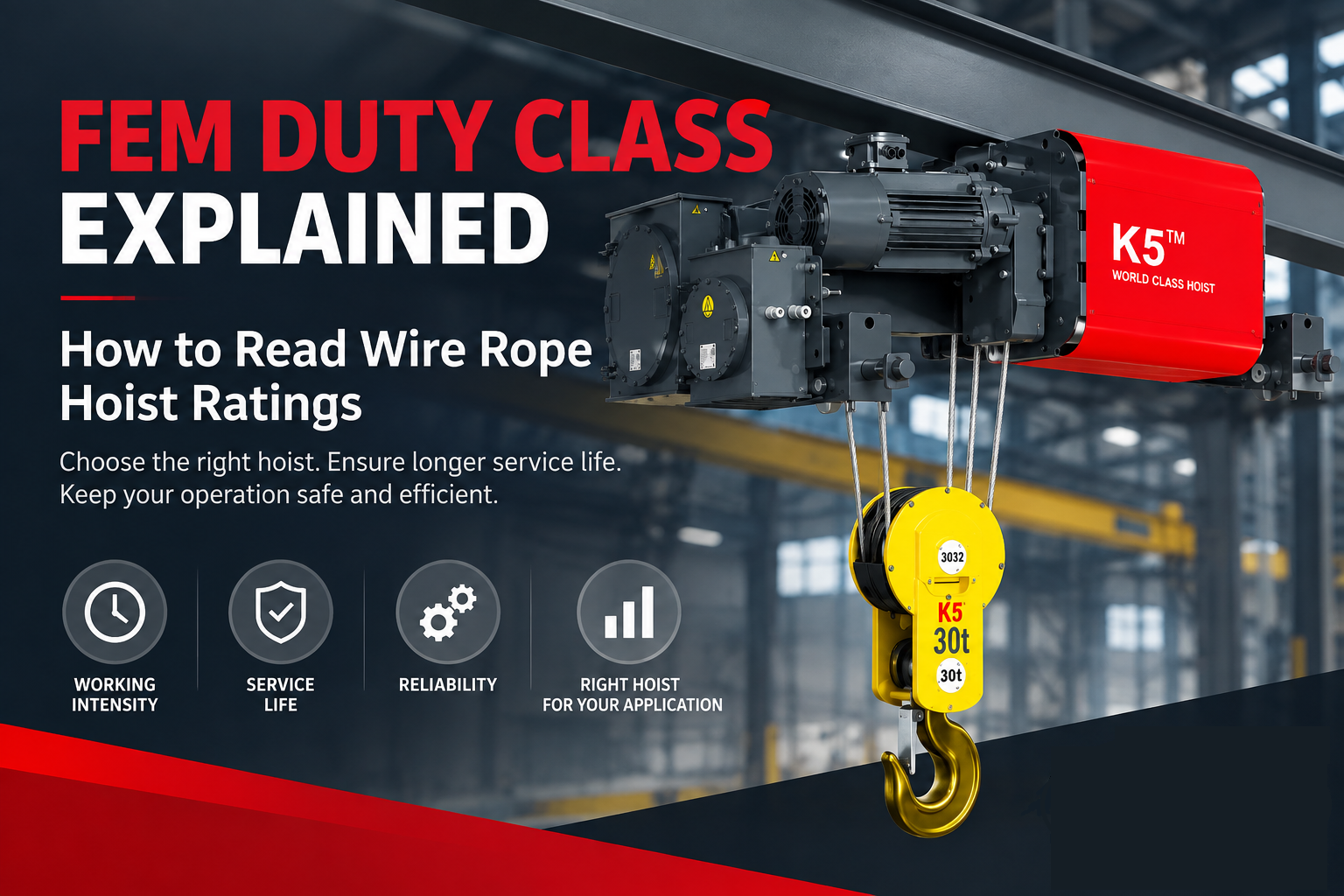
For 2–10 ton electric wire rope hoists, FEM duty classification is a primary selection criterion. Rated capacity indicates the maximum load a hoist can lift, while the FEM class reflects the workload its mechanism is designed to withstand throughout its service life.
FEM classifies hoisting mechanisms according to load spectrum and total operating time. Therefore, two 5-ton hoists may require different duty classes if one handles occasional moderate loads while the other frequently lifts near rated capacity.
This difference is why FEM compliance is an engineering baseline rather than a premium feature: it confirms whether the hoist’s duty class matches its intended workload. Only after this match is established do comparisons of components, service, and price become meaningful.
The Premium Brand Trap — Are You Paying for the Name?
The premium brand trap begins when buyers use price as a shortcut for judging quality. For a 2–10 ton electric wire rope hoist, a higher quotation does not automatically represent a higher FEM duty class, longer design life, or better suitability for the application.
What Traditional Premium Brands Charge For
In some quotations, established premium brands can cost 50% to 100% more than value-oriented alternatives. This difference may include brand positioning, distributor margins, regional sales and service infrastructure, extended warranties, local compliance documentation, and custom engineering.
These benefits can support specific projects, but they should be separated from the mechanical performance of the hoist itself.
Where the Spec Sheet Tells a Different Story
The specification sheet shows whether the price premium delivers additional operating capability. Buyers should compare FEM duty class, motor duty cycle, braking, wire rope, protection rating, safety controls, and service coverage.
If two hoists meet the same required duty class and application conditions, the higher price needs to be supported by measurable advantages such as faster service, stronger parts availability, or useful customization. This approach prevents buyers from paying for brand reputation when the project mainly requires verified performance and reliable support.
What Makes a Hoist “Good Value” Without Compromising Compliance
Once price is separated from brand position, hoist value can be defined through measurable product characteristics. A high-value 2–10 ton electric wire rope hoist has four essential qualities.
FEM-Compliant Design at a Competitive Price Point
- Correct duty classification:Its FEM/ISO class matches the average load, lifting frequency, and daily operating time. This provides the required design life while keeping the equipment investment aligned with the actual workload.
- Serviceable construction: Its motor, brake, wire rope, gearing, and protection rating suit the operating environment. Modular assemblies and standardized replacement parts help control maintenance time, spare-parts costs, and downtime.
Safety Standards and Certifications That Match the Benchmark
- Essential safety functions: Overload protection, upper and lower limit switches, emergency stop, and motor thermal protection are included as part of the working system.
- Verifiable compliance: Duty-class records, factory load-test reports, operating manuals, and market-specific conformity documents correspond to the supplied model and configuration.
Together, these qualities provide suitable performance, verifiable compliance, and predictable maintenance at a competitive lifecycle cost.
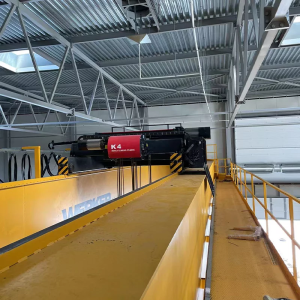
Key Factors to Compare Before You Buy
Compare all quotations against the same load profile, lifting frequency, operating hours, lift height, speed, and working environment. This ensures that technical and price differences are meaningful.
Duty Class and Certifications
The FEM/ISO duty class should match the actual load spectrum and average daily hoisting time. The table below provides a practical selection reference for the commonly used M4, M5, and M6 classes.
Load Spectrum | M4 / FEM 1Am | M5 / FEM 2m | M6 / FEM 3m |
Light | 2–4 h/day | 4–8 h/day | 8–16 h/day |
Medium | 1–2 h/day | 2–4 h/day | 4–8 h/day |
Heavy | 0.5–1 h/day | 1–2 h/day | 2–4 h/day |
Very heavy | 0.25–0.5 h/day | 0.5–1 h/day | 1–2 h/day |
Certification requirements depend on the destination and operating environment. European projects may require a CE Declaration of Conformity, North American projects may require applicable UL or CSA documentation, and hazardous environments may require ATEX or IECEx certification.
Component Specs and Build Quality
Compare motor duty cycle, IP rating, insulation class, thermal protection, and speed control. IP55 and Class F or H insulation are common references, while harsher environments may require additional protection.
Also review the brake, gearbox, wire rope, drum, sheaves, and rope guide. Accessible components and standard replacement parts can reduce maintenance time and simplify future repairs.
Total Cost of Ownership
Compare every quotation over the same period using:
- TCO = Purchase + Installation + Operating + Maintenance + Downtime Costs − Residual Value
Include energy, inspections, lubrication, replacement parts, service labor, delivery, and expected downtime. This shows whether the initial price remains competitive throughout the equipment’s service life.
After-Sales Support and Service Network
Confirm responsibility for installation, commissioning, training, maintenance, and troubleshooting. Response time, technician coverage, spare-parts lead time, and warranty terms should be clearly stated.
For high-cycle applications, operating-hour meters, load-spectrum monitoring, fault records, and remote diagnostics can support planned maintenance and reduce unexpected downtime.
Customization and Adaptability — The Hidden Value Advantage
Beyond FEM compliance, component quality, and service, adaptability also affects the value of a 2–10 ton electric wire rope hoist.
For example, a low-headroom arrangement preserves vertical lifting space, while the correct lifting height, trolley configuration, power supply, and control interface simplify system integration. Variable-speed control supports precise positioning, corrosion-resistant coatings suit outdoor or corrosive sites, and certified explosion protection addresses specified hazardous areas.
When selected within the required FEM/ISO duty class and safety requirements, these options improve application fit while keeping compliance as the engineering baseline.
WORLDHOISTS Wire Rope Hoists – FEM-Compliant, Better Value
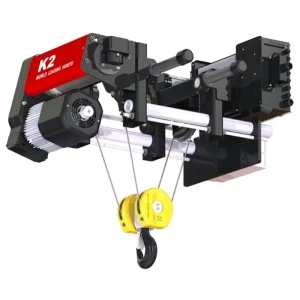
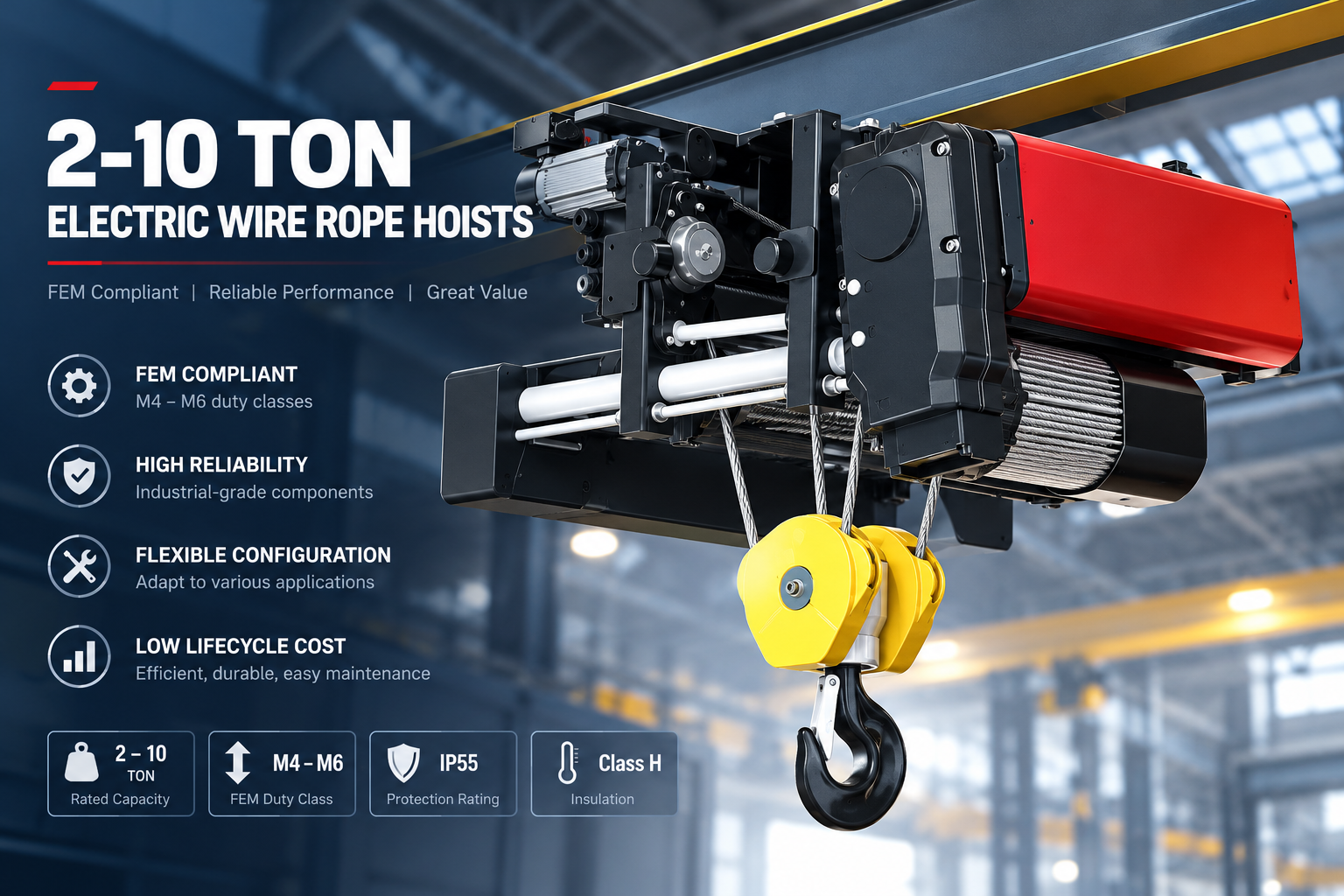
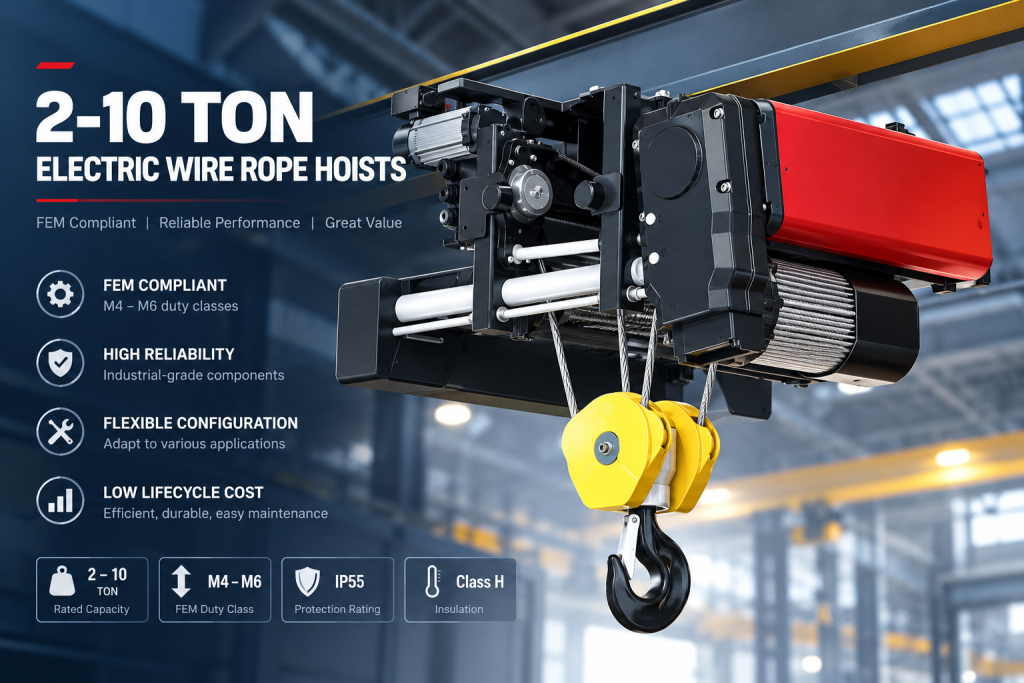
For buyers comparing 2–10 ton electric wire rope hoists, WORLDHOISTS offers a balanced combination of industrial performance, flexible configuration, and ongoing service support. Its wire rope hoists are available in M4–M6 duty classes and come standard with IP55 protection, Class H insulation, and a 60% ED motor duty cycle.
Core components include 2160 N/mm² galvanized wire rope, a DIN 34CrMo4 T-class hook, an electromagnetic disc brake, and a hardened gear reducer. Standard two-speed lifting, optional stepless control, an inverter-driven trolley, and a low-headroom structure allow the equipment to suit different handling and installation requirements.
Customization covers lifting height, duty class, control functions, and configurations for explosion-proof, anti-corrosion, and extreme-temperature environments. Service support is provided by more than 60 installation specialists and 150 maintenance engineers, with remote assistance, on-site repair, operator training, and warranty options.
This combination makes WORLDHOISTS a practical, value-focused choice for buyers seeking FEM-compliant performance, adaptable design, and dependable support.
Make Every Hoist Investment Work Harder
Choosing a 2–10 ton electric wire rope hoist comes down to matching FEM duty class, components, safety documentation, lifecycle costs, and service to the real application. WORLDHOISTS combines M4–M6 duty options, adaptable configurations, industrial components, and ongoing technical support to deliver practical value. Review your operating conditions, compare quotations on the same basis, and contact WORLDHOISTS to configure the right hoist for your project.
FAQs
Can a non-European brand truly meet FEM standards?
Yes. FEM is an engineering standard, not a regional certification. Any manufacturer that designs and tests to FEM specifications can achieve full compliance. WORLDHOISTS wire rope hoists are designed to FEM standards from M4 to M6, with rigorous quality control throughout the manufacturing process.
How do I verify a hoist is actually FEM-compliant?
Check the manufacturer’s technical documentation for duty class ratings, design calculations, and third-party certifications. WORLDHOISTS provides full technical specifications and support documentation to verify compliance for each model.
Will I sacrifice after-sales support by choosing a value-oriented brand?
Not with the right manufacturer. WORLDHOISTS has 60+ installation specialists and 150+ maintenance engineers, offering remote support, on-site repairs, operator training, and an extended warranty — on par with leading premium brands.
Reference
[1]https://www.nucleon-cranes.cn/news/blog/fem-wire-rope-vs-chain-hoist/