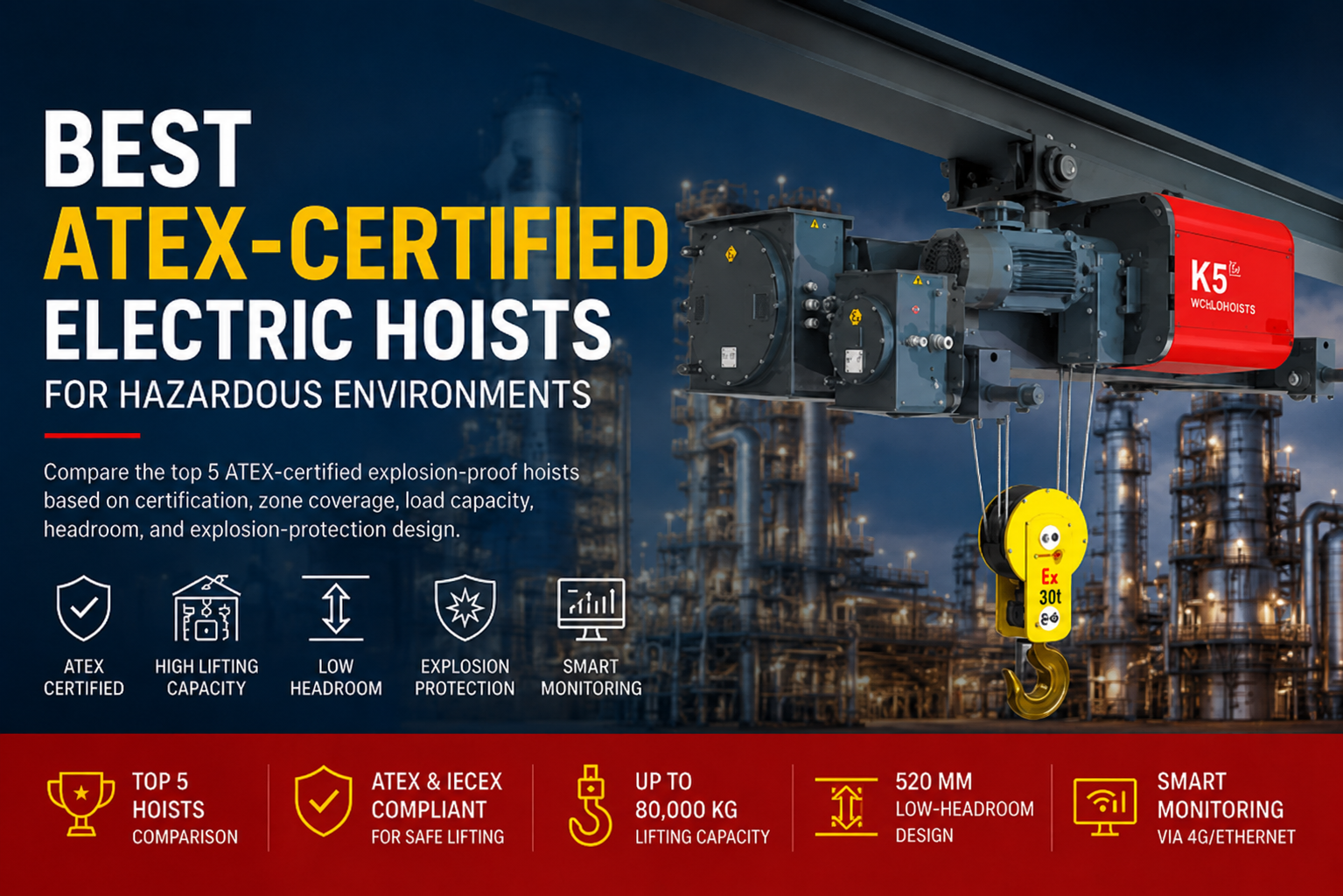
Explosion-proof hoists are essential for safe lifting in hazardous environments such as oil and gas facilities, chemical plants, mining sites, and power stations. This guide compares five ATEX-certified electric wire rope hoists based on primary engineering focus, structural configuration, control systems, and verified capacity ranges. We also highlight their key strengths, limitations, and best-use scenarios to help buyers identify the most suitable option for different industrial applications.
Our Top Pick
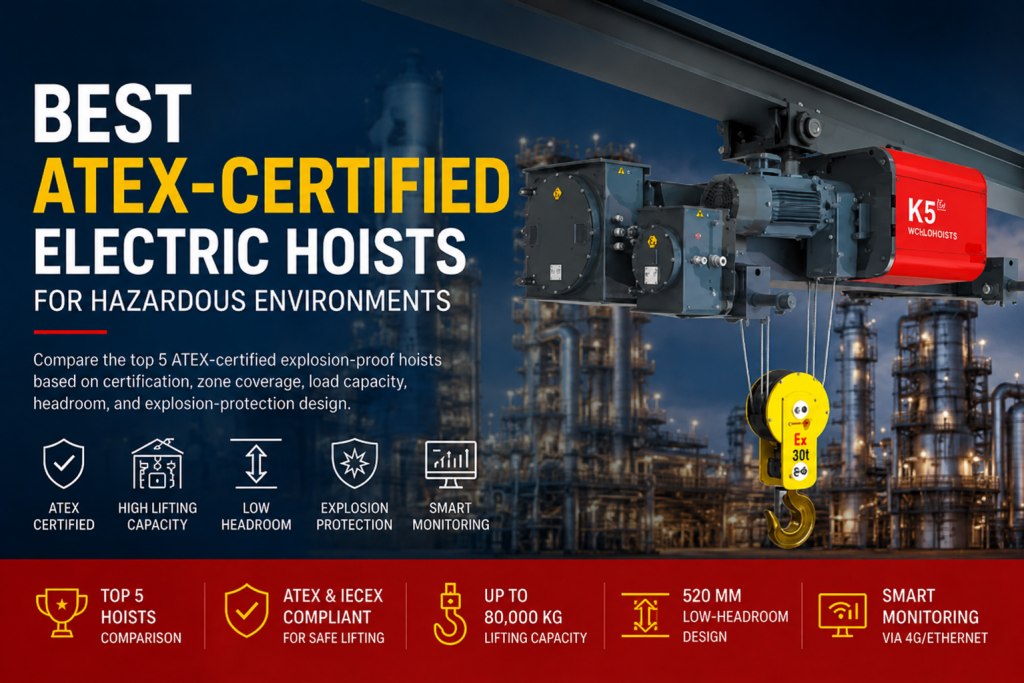
WORLDHOISTS Explosion-Proof Hoist — Best Overall
Among the five explosion-proof hoists reviewed in this guide, WORLDHOISTS offers a strong combination of lifting capacity, installation efficiency, and intelligent monitoring features.
The hoist features a 520 mm low-headroom design, ATEX certification, compliance with EN/IEC/GB standards, up to 80,000 kg lifting capacity, and an integrated condition monitoring system. These features make it suitable for demanding hazardous environments such as oil and gas facilities, petrochemical plants, power stations, mining sites, and shipyards.
Top 5 ATEX-Certified Explosion-Proof Hoists
- Best Overall:WORLDHOISTS Explosion-Proof Hoist
- Best for Standardized Compliance: Standardized Chemical-Industry Wire Rope Hoist (Brand A)
- Best for Rugged Durability:Classic Heavy-Duty Explosion-Proof Wire Rope Hoist (Brand B)
- Best for European-Style Compliance: Modular European-Style Explosion-Proof Wire Rope Hoist (Brand C)
- Best for Heavy-Duty Capacity Range: Heavy-Duty Modular Explosion-Proof Wire Rope Hoist (Brand D)
Comparison of the Top 5 Explosion-Proof Hoists
Choosing the right explosion-proof hoist requires careful evaluation of its primary engineering focus, structural configuration, control and monitoring systems, and verified capacity range.
The table below compares these five hoists across the key factors.
Brand | Primary Engineering Focus | Structural Configuration | Control & Monitoring System | Verified Capacity Range |
WORLDHOISTS | Low-Headroom & Smart Integration | Ultra-Low Headroom (520mm) | Integrated IoT (4G/Ethernet) | Up to 80 Tons |
Brand A | Standardized Chemical Compliance | Standard Factory EX Frame | Standard EX Controls | 3 to 80 Tons |
Brand B | Budget-Friendly Rugged Durability | HB Stationary / Fixed Type | Standard EX Controls | 0.5 to 16 Tons |
Brand C | European-Style Compliance | Flexible Modular Design | Standard EX Controls | – |
Brand D | Heavy-Duty Capacity Range | Heavy-Duty Modular Design | Standard EX Controls | 3.2 to 50 Tons |
Each of these explosion-proof wire rope hoists is engineered to meet specific hazardous environment requirements. Brand A focuses on standardized chemical compliance, Brand B provides traditional rugged durability, Brand C delivers highly regulated European-style modularity, and Brand D specializes in heavy-duty capacity ranges.
For projects requiring a balance of heavy lifting capacity, installation efficiency, and smart monitoring capability, WORLDHOISTS offers a comprehensive solution with up to 80-ton capacity, an ultra-low headroom design (520mm), full ATEX certification, and integrated smart condition monitoring.
In-Depth Reviews of the Top 5 Explosion-Proof Hoists
Top 1: WORLDHOISTS Explosion-Proof Wire Rope Hoist
This WORLDHOISTS explosion-proof hoist combines ATEX-compliant explosion protection with a compact, low-headroom design, making it well-suited to hazardous-area facilities where space and installation cost are key concerns.
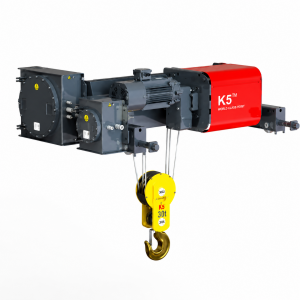
Key Features: ATEX-certified (Ex d IIB T4 / Ex d IIC T4 / Ex de IIB T4 / Ex de IIC T4) for Zone 1/2 areas, up to 80 tons capacity, duty classes M3–M6.
Pros:
- 520 mm low-headroom design cuts building height by roughly 1 meter versus traditional hoists, lowering construction costs
- Flexible drive design reduces internal stress and improves transmission efficiency
- Standard variable-frequency trolley enables smoother, more controlled travel
- Duty classes M3–M6 cover both light maintenance and continuous heavy-duty use
- Smart monitoring tracks overloads and wear parts remotely via 4G/Ethernet
Cons: Fewer long-term reference cases in very large-scale, high-consequence installations compared with long-established European brands.
Use Case: Suited for petrochemical plants, oil and gas refineries, power stations, mining sites, and shipyards — particularly projects where reduced building height directly lowers construction cost.
Top 2: Standardized Chemical-Industry Wire Rope Hoist (Brand A)
Built to stringent safety specifications, this standardized explosion-proof wire rope hoist is a highly reliable workhorse frequently deployed across the rigorous petrochemical sector.
Key Features: Designed specifically for factory explosive gas mixtures, featuring standard EX d IIB T4 or EX d IIC T4 explosion-proof ratings, available in standard single- or double-girder configurations.
Pros: The highly standardized components ensure long-term operational reliability and straightforward regulatory compliance for standard factory hazardous zones.
Cons: Its traditional structural frame requires significant vertical installation space, lacking the building-cost-saving benefits of specialized low-headroom configurations.
Best Use Case: Ideal for large-scale chemical plants and legacy industrial facilities with ample overhead clearance that prioritize standardized EX equipment.
Top 3: Classic Rugged Explosion-Proof Wire Rope Hoist (Brand B)
Utilizing a traditional layout, this classic explosion-proof wire rope hoist is a widely adopted and highly cost-effective solution for standard hazardous environments.
Key Features: Based on the classic HB-series design, offering single or double lifting speeds. It utilizes a stationary or fixed structural layout tailored for standard anti-explosion requirements.
Pros: Its widespread market adoption means the traditional mechanics are universally understood, and its rugged simplicity makes basic maintenance very straightforward.
Cons: The classic HB-type design is notably bulkier and heavily consumes factory headroom. It entirely lacks modern intelligent condition monitoring features.
Best Use Case: Best suited for traditional heavy industries and mining operations where vertical space is completely unrestricted and budget-friendly, manual maintenance is a priority.
Top 4: Modular European-Style Explosion-Proof Wire Rope Hoist (Brand C)
Featuring a European-style design, this explosion-proof wire rope hoist provides a safe and highly regulated lifting solution for demanding gas and dust environments.
Key Features: Engineered to European safety standards, it fully conforms to the 94/9/EC (ATEX 95) directives and strictly adheres to IECEx global regulations for explosion-proof equipment.
Pros: Its strict adherence to dual international directives (ATEX and IECEx) ensures top-tier compliance and globally recognized safety standards for international projects.
Cons: High-end European compliance and structural integration typically come with higher initial investment costs and slightly more complex specialized maintenance.
Best Use Case: Suitable for international energy projects and large-scale manufacturing facilities that require strict adherence to European ATEX 95 directives.
Top 5: Heavy-Duty Modular Explosion-Proof Wire Rope Hoist (Brand D)
This modular explosion-proof wire rope hoist is a specialized lifting solution designed specifically for heavy-duty industrial applications.
Key Features: Features a modular wire rope electric hoist design with lifting capacities ranging from 3,200 kg to 50,000 kg. Its structure is engineered for highly demanding lifting operations.
Pros: The robust wire rope configuration and expansive capacity range provide significant advantages for large-scale projects involving extremely heavy loads and high-frequency lifting requirements.
Cons: Due to its heavy-duty framework designed for massive capacities, it requires a larger structural footprint and more vertical installation clearance compared to specialized low-headroom configurations.
Best Use Case: Suitable for heavy industries, energy projects, and large-scale material handling applications requiring reliable high-capacity lifting equipment.
How to Choose an Explosion-Proof Hoist
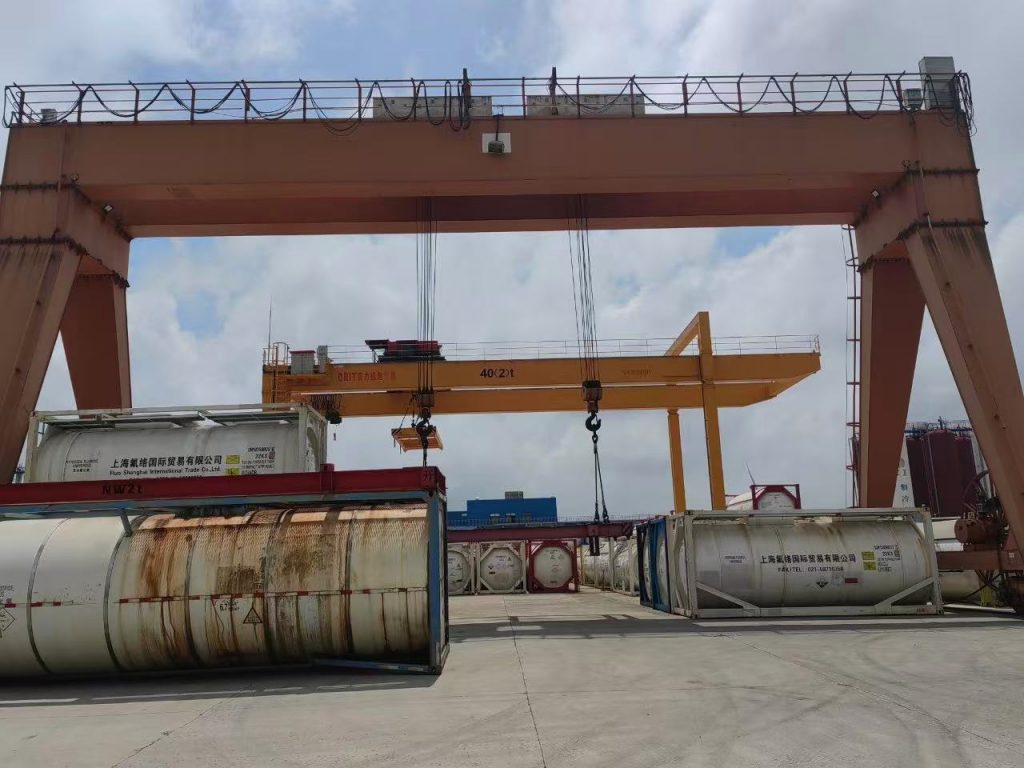
Selecting an explosion-proof hoist is not only about lifting capacity. Buyers need to consider the hazardous environment, operating frequency, installation conditions, and long-term reliability requirements to ensure the equipment matches the actual application.
Check ATEX Certification
Certification should be the first consideration when selecting an explosion-proof hoist. Check whether the hoist meets the required explosion-protection standards, such as ATEX, and confirm that the certification is suitable for the regulations and requirements of the installation location.
Check Zone Coverage
Before choosing a hoist, identify the hazardous area classification of the working environment. Determine whether the site involves explosive gases or combustible dust, and select equipment designed for the required zone, such as Gas Zone 1/2 or Dust Zone 21/22.
Select the Right Load Capacity
Choose the hoist capacity according to the actual lifting requirements of the application. Consider the maximum load, lifting accessories, and operating conditions to ensure the equipment can provide safe and reliable performance without unnecessary oversizing.
Check the Required Duty Class
The required duty class depends on how frequently the hoist will operate and the intensity of the lifting tasks. Hoists used for continuous production operations require a higher duty classification, while equipment for occasional maintenance work may have different requirements.
Consider Headroom and Installation Space
Installation conditions should be evaluated before final selection. Check the available building height, lifting space, and equipment layout. For applications with limited vertical clearance, a low-headroom hoist design can help increase usable lifting height and improve installation efficiency.
Final Verdict
Choosing the right explosion-proof hoist depends on certification, zone requirements, lifting capacity, and installation conditions. Among the options reviewed, WORLDHOISTS stands out with its ATEX certification, up to 80,000 kg capacity, 520 mm low-headroom design, and smart monitoring features. Contact WORLDHOISTS for a suitable lifting solution tailored to your application needs.
FAQs
Q: Which Explosion-Proof Hoist Is Suitable for Low-Headroom Installations?
A: A low-headroom hoist is a better choice when vertical space is limited, as it allows more usable lifting height. The WORLDHOISTS Explosion-Proof Hoist, for example, uses a 520 mm low-headroom design.
Q: What Information Should I Provide When Requesting an Explosion-Proof Hoist Quote?
A: Suppliers typically need details such as required capacity, lifting height, hazardous-area classification, duty requirements, power supply, and installation dimensions. Providing these specifications helps manufacturers such as WORLDHOISTS recommend a more appropriate Explosion-Proof Hoist configuration.
Q: Are Explosion-Proof Hoists Suitable for Both Indoor and Outdoor Use?
A: They can be, but outdoor use depends on the hoist’s enclosure protection, ambient temperature range, and resistance to rain, dust, and corrosion. The WORLDHOISTS Explosion-Proof Hoist provides flameproof and increased-safety explosion protection for Zone 1/2 applications; its suitability for a specific outdoor environment should be confirmed based on the required configuration.