Hoist reliability depends not only on load capacity, but also on how the motor, gearbox, brake, and overall drive system are designed to work together. Three-in-one drive wire rope hoists use an integrated drive arrangement that combines key drive components into a compact unit, while traditional hoists typically use a more separated drive structure.
This guide compares both designs across performance, maintenance, environmental resistance, and long-term reliability to help determine which is better suited to different industrial applications.
What Is a Three-in-One Drive Wire Rope Hoist?
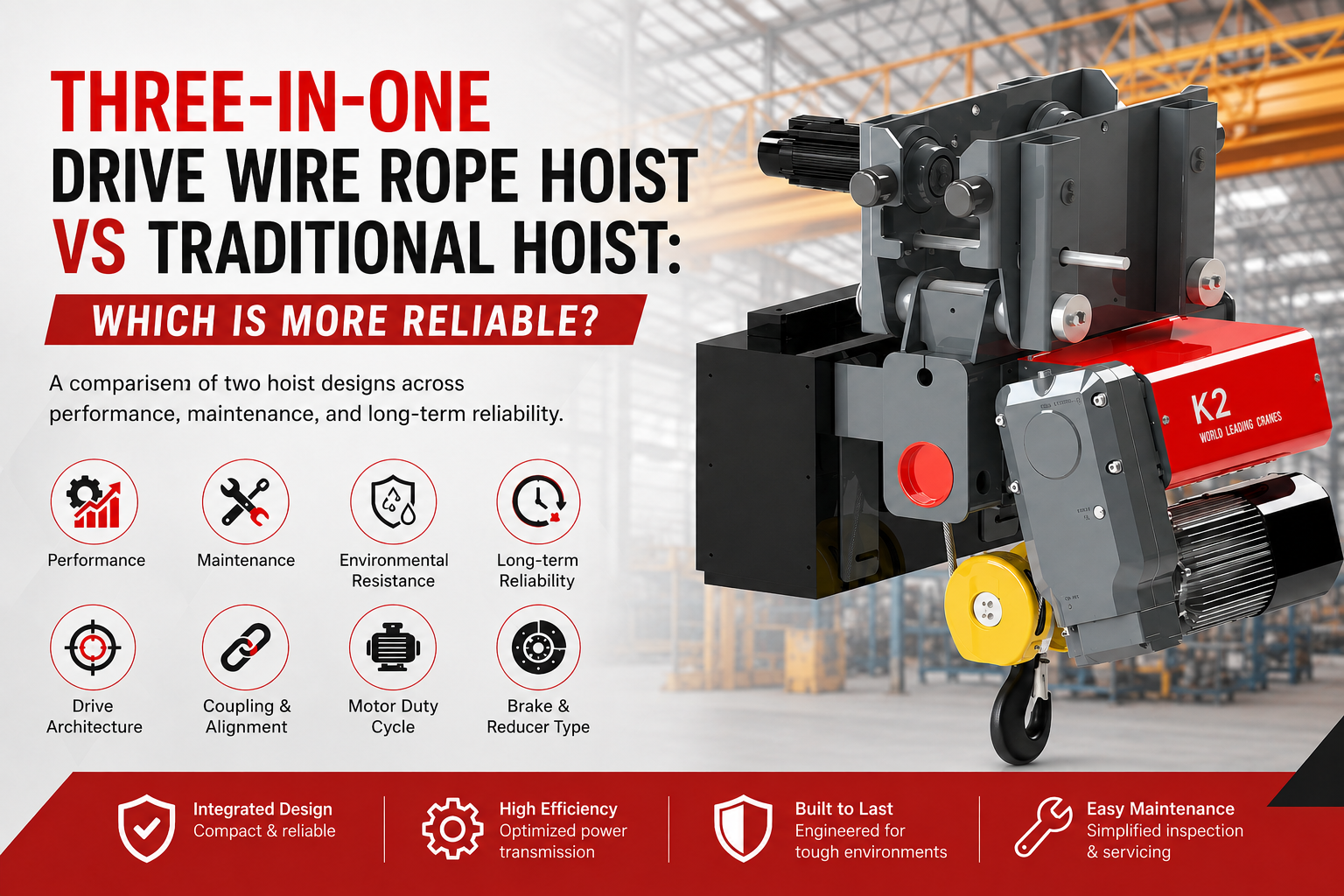
A three-in-one drive wire rope hoist is a wire rope hoist equipped with an integrated gearmotor drive that combines key drive functions into a compact unit, reducing the need for separate couplings and external transmission components.
Key features: The drive assembly combines the motor, reducer, and brake into one integrated unit. Because these three components share a single housing rather than being connected through external couplings, the hoist has a more compact structure and a simplified transmission layout.
Advantages
- l Easier installation
- l Smaller footprint
- l Potentially higher transmission efficiency
- l Fewer external transmission components
Disadvantages
- l Less flexibility for component-level repairs
- l Major faults may require servicing a larger integrated assembly
- l Replacement parts may be more design-specific
What Is a Traditional Wire Rope Hoist?
A traditional hoist typically uses a more separated drive arrangement, with drive components connected through conventional mounting and transmission structures.
Key features: The motor, reducer, and brake are mounted separately rather than sharing one housing. Because they are connected through external couplings instead, the hoist has multiple connection points, and each component can be serviced on its own.
Advantages
- l Flexible component-level repairs
- l Greater flexibility in component selection
- l Familiar maintenance structure
Disadvantages
- l Larger installation footprint
- l More coupling and alignment points
- l More individual components to inspect and maintain
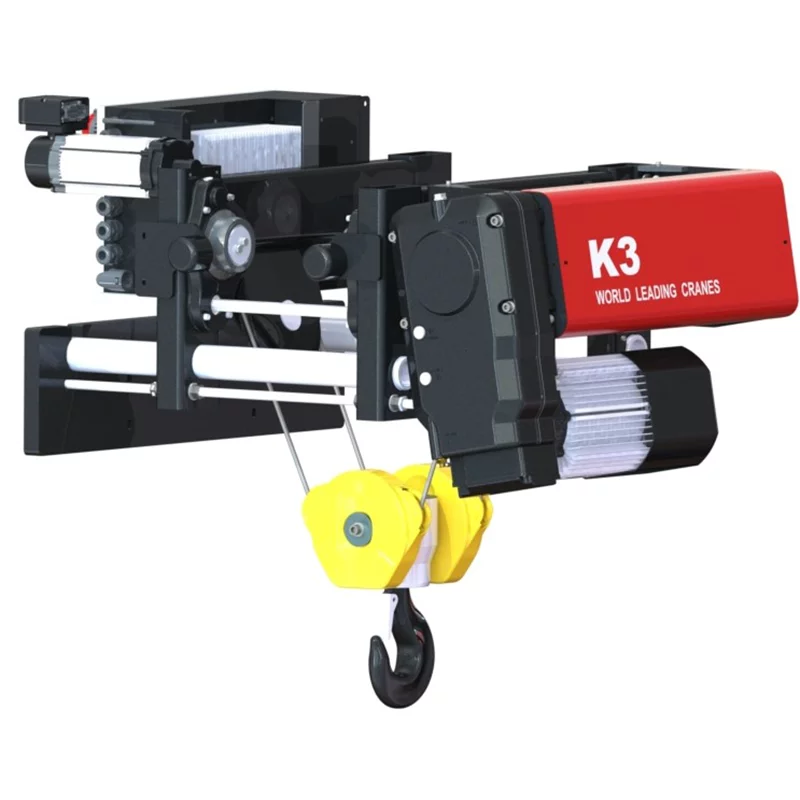
Three-in-One Drive Wire Rope Hoist vs Traditional Hoist: 7 Key Differences
Comparing these two designs comes down to eight criteria. Each one affects a different part of the hoist’s performance, from installation to daily operation to long-term upkeep.
Drive Architecture
Drive architecture is how the motor, reducer, and brake are arranged relative to each other, whether integrated into one unit or mounted as separate components. It sets the baseline for how much of the drive system needs to be assembled and connected during installation.
Coupling & Alignment
This is the number of connection points between drive components and how precisely they need to be aligned. Every additional coupling is another point where misalignment can develop, and that affects how smoothly the hoist runs over time.
Protection Rating
Protection rating describes how well the housing keeps out dust and moisture, typically expressed as an IP rating. A higher rating means the drive components stay better shielded from airborne particles and humidity during operation.
Motor Duty Cycle
The duty cycle is the ratio of a motor’s working time to its rest time within a given cycle, usually expressed as a percentage (ED%). Because it defines how much continuous or repeated use the motor can handle without overheating, it also sets the practical limit on how hard the hoist can be run.
Reducer Type
The reducer is the specific gear arrangement used to reduce motor speed and increase torque. Its design shapes transmission efficiency and how much load the drive system can carry reliably.
Brake Type
Brake type is the mechanism used to stop and hold the load, such as an electromagnetic disc brake. Different types vary in stopping precision and in how easily they can be inspected, adjusted, or replaced.
Maintenance & Serviceability
This criterion covers how the hoist is inspected and repaired — as a complete assembly, or component by component. It essentially decides how much of the hoist has to be taken apart when something goes wrong.
Comparison Table: Three-in-One Drive vs Traditional Hoist by Criteria
| Criteria | Three-in-One Drive Hoist | Traditional Hoist |
|---|---|---|
| Drive Architecture | Motor, reducer, and brake integrated into one unit | Motor, reducer, and brake mounted as three separate units |
| Coupling & Alignment | Few or no external couplings between drive components | Multiple couplings connecting each drive component |
| Protection Rating | One IP rating covers the whole drive unit | IP rating differs from component to component |
| Motor Duty Cycle | Tied to the rated duty cycle of the whole drive unit | Specified for the motor alone, independent of other components |
| Reducer Type | Fixed as part of the integrated drive unit | Selected separately, with more options to choose from |
| Brake Type | Fixed as part of the integrated drive unit | Selected and replaced independently of the motor and reducer |
| Maintenance & Serviceability | A fault typically means replacing the whole unit | A fault can usually be isolated to one component |
What Really Drives Hoist Reliability? Analysis and Insights
The differences between three-in-one drive hoists and traditional hoists are not only structural. They directly affect how the equipment handles environmental exposure, mechanical stress, operating cycles, and maintenance requirements. Understanding these factors helps determine which design is better suited for a specific application.
Sealing Reduces Environmental Exposure
Dust and moisture are common causes of premature wear in drive components, making protection an important factor in hoist reliability.
A three-in-one drive uses an integrated housing that reduces the number of external connection points exposed to the environment. This helps simplify sealing and limits potential entry points for contaminants. Traditional hoists use separate housings for each drive component, meaning protection depends on the condition of multiple seals and connections.
Structural Alignment Supports Drive Reliability
Alignment accuracy affects bearing loads, shaft wear, and overall transmission stability.
With a three-in-one drive hoist, the motor, reducer, and brake are assembled as a single unit, reducing the alignment requirements between major drive components. Traditional hoists rely on external couplings to connect separately mounted components, making installation accuracy and regular inspection more important for maintaining smooth operation.
Duty Cycle Defines the Operating Reliability Envelope
Regardless of the drive structure, a hoist must operate within its rated duty cycle, load capacity, and operating conditions.
The duty cycle determines how frequently the motor can run while maintaining acceptable temperature and wear levels. Operating beyond these limits can increase heat buildup, accelerate component wear, and shorten service life. Therefore, selecting a hoist that matches the actual workload remains essential for long-term reliability.
Serviceability Shapes Long-Term Reliability
Reliability also depends on how efficiently a hoist can be inspected, repaired, and returned to operation after a fault.
An integrated drive simplifies the overall structure and reduces external service points, but internal faults may require servicing the complete drive assembly. Traditional hoists allow technicians to isolate individual components, which can make certain repairs more targeted and flexible. The better choice depends on whether a facility prioritizes simplified design or component-level serviceability.
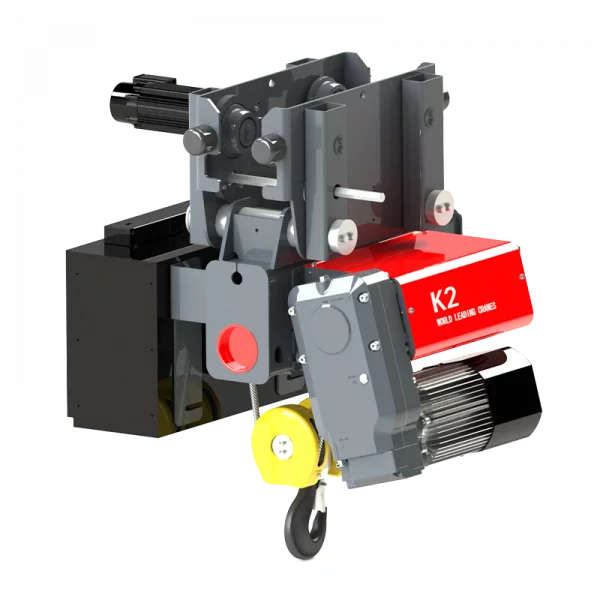
Three-in-One Drive Wire Rope Hoist vs Traditional Hoists: Which Design Is Best for Your Application?
Based on these differences, each hoist design is better suited to different operating conditions and application requirements.
Best suited for Three-in-One Drive Hoists:
- l Space-constrained installations
- l Retrofit projects with limited installation space
- l Automated production lines requiring compact drive arrangements
- l Applications prioritizing simplified installation and fewer external drive components
Best suited for Traditional Hoists:
- l Facilities prioritizing component-level repairability
- l Sites with established spare-parts inventories
- l Plants with established maintenance practices for conventional hoists
- l Existing crane fleets where compatibility with legacy equipment is important
Looking for the Right Wire Rope Hoist? Explore WORLDHOISTS Solutions
WORLDHOISTS wire rope hoists are designed with a focus on operational reliability, safety, and long-term performance. By combining durable components with practical design features, these hoists help meet the demands of different industrial lifting applications while improving efficiency and reducing maintenance requirements.
- l Heavy-Duty Fan-Cooled Hoist Motor: Maintains performance in continuous or high-duty cycles.
- l Standard Guide Rollers: Ensure smooth trolley movement along crane rails.
- l Built-In Drop Stops: Prevent accidental hook drops and enhance safety.
- l Full 360° Rope Guide: Ensures proper winding and prevents rope overlap or tangling.
- l Large Rope Drum: Reduces hook drift and extends wire rope life.
- l Externally Adjustable Trolley Motor and Brake: Convenient tuning for optimal performance.
With features designed for smoother operation, enhanced safety, and reduced component wear, WORLDHOISTS wire rope hoists provide a reliable solution for applications requiring consistent lifting performance. Whether for new installations or equipment upgrades, selecting the right hoist configuration can help improve productivity and support long-term operational goals.
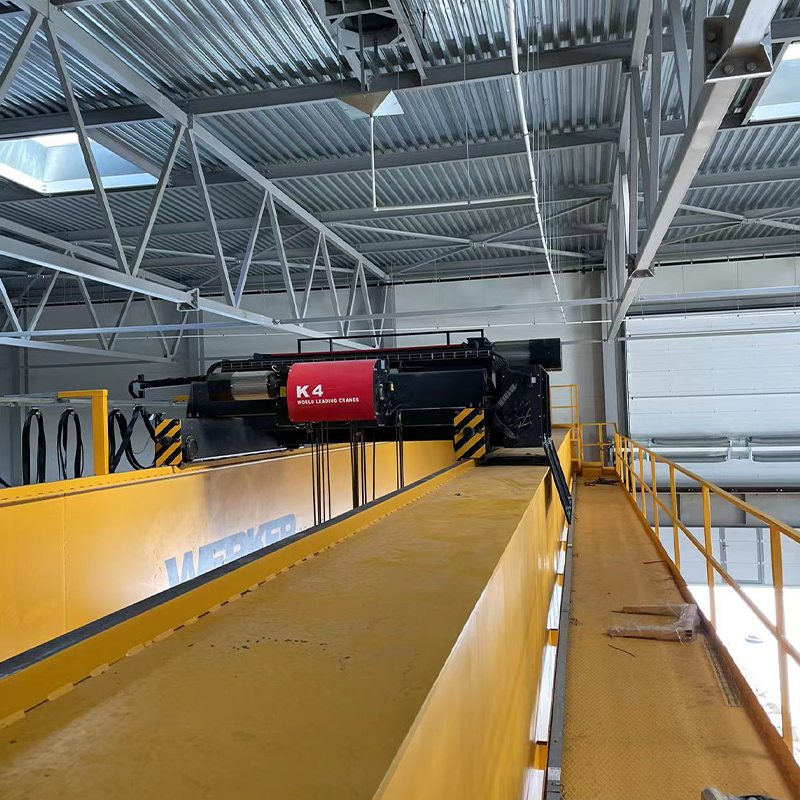
Choosing the Right Hoist Design for Long-Term Reliability
Choosing between a three-in-one drive wire rope hoist and a traditional hoist depends on the specific requirements of your application. Integrated drive designs offer compact structure and simplified installation, while traditional designs provide greater maintenance flexibility. WORLDHOISTS provides reliable wire rope hoist solutions tailored to different lifting needs. Contact us today to discuss your requirements and find the right hoist solution for your project.
FAQ
Q: How long does a hoist like this typically last before major components need replacing?
A: Service life depends heavily on how closely actual usage matches the rated duty cycle and load capacity, but components built with wear reduction in mind, such as a large diameter drum that minimizes hook drift, tend to extend the working life of the wire rope specifically. WORLDHOISTS designs its K Series and H Series with this kind of wear reduction built in, which is one of the factors behind its stated focus on long service life and low maintenance.
Q: If something goes wrong, how quickly can I actually get support or a replacement part?
A: Response time depends on whether the manufacturer has a real service infrastructure, not just a sales team, since remote troubleshooting can resolve some issues while others need an on-site visit. WORLDHOISTS backs its hoists with a team of over 60 installation specialists and 150 maintenance engineers offering remote support and on-site repairs, which matters more once a facility is past the warranty period and needs fast turnaround.
Q: Can this type of hoist be adapted if my facility has unusual space or environmental constraints?
A: Standard models are built around common capacity, height, and environmental ranges, but facilities with non-standard headroom, explosion-proof requirements, or extreme temperatures often need a configuration outside the catalog spec. WORLDHOISTS offers this kind of customization directly, including non-standard designs and adaptations for special environments, which avoids forcing a facility to compromise on a standard unit that doesn’t quite fit.