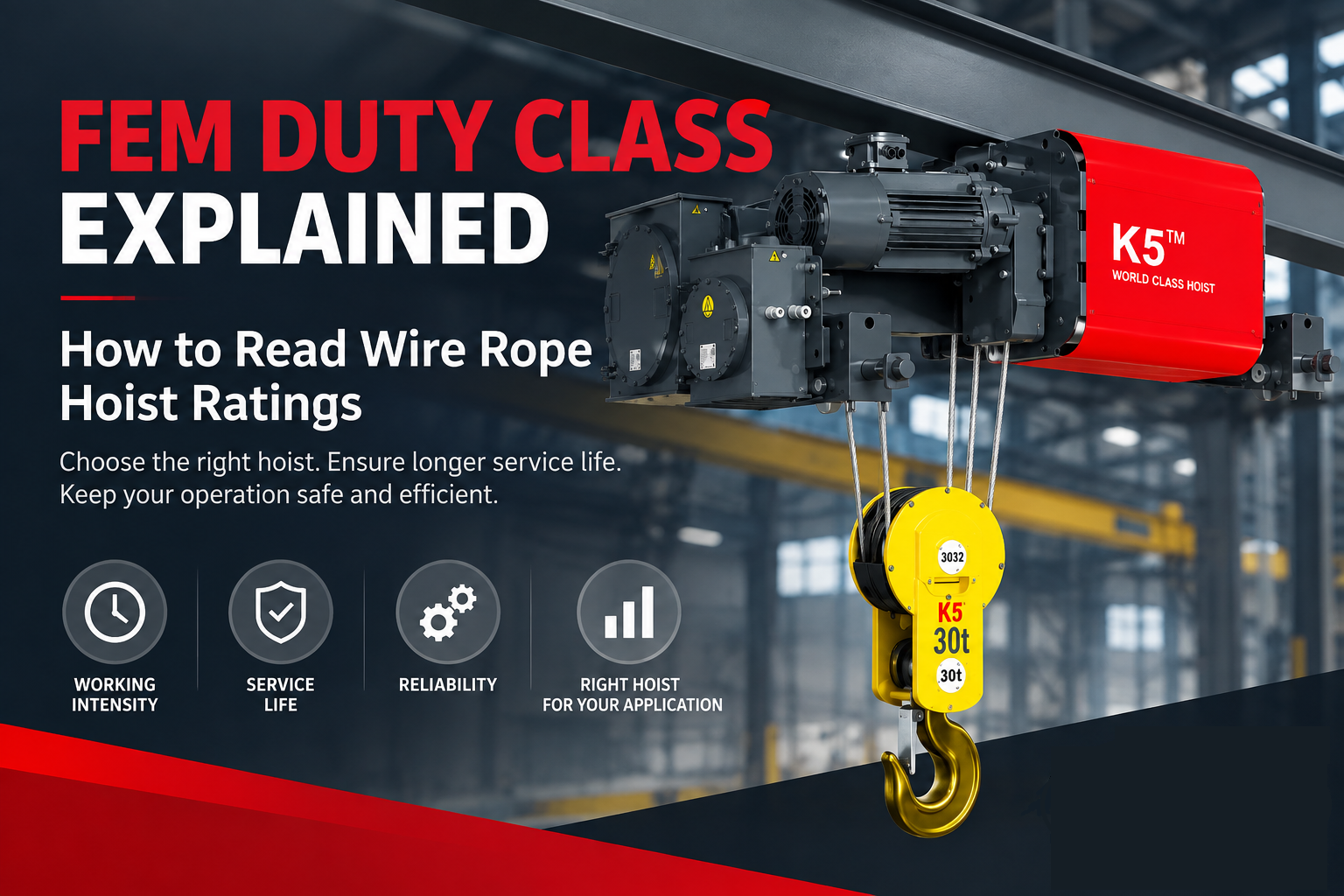
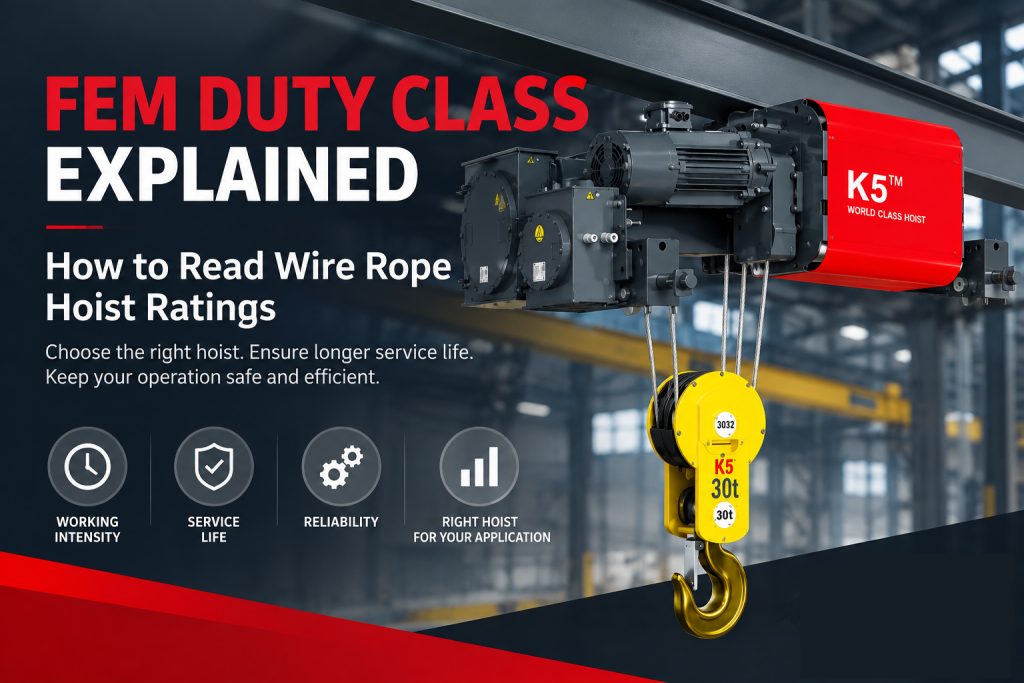
When selecting a wire rope hoist, many customers focus on lifting capacity, speed, and lifting height. However, these factors alone cannot determine whether a hoist is suitable for long-term operation. FEM Duty Class is a key factor that defines the working intensity, service life, and reliability of a hoist. Understanding FEM classification helps users choose the right hoist for their specific application, especially in demanding industries where safety and continuous operation are critical.
What Is FEM Duty Class?
The FEM (European Materials Handling Federation) Duty Class is a standardized metric that predicts how long a hoist mechanism will perform reliably. Many buyers experience premature equipment failure because they purchase hoists based solely on weight capacity. The FEM rating solves this by measuring actual mechanical wear against your daily workflow, helping you avoid costly maintenance downtime.
The Two Core Determining Factors
To assign an accurate FEM rating, you must evaluate two operational metrics together. Overlooking either factor often leads to underspecifying your lifting equipment.
- Load spectrum: This measures how frequently the hoist lifts heavy loads compared to lighter loads. Constantly lifting near maximum capacity stresses internal components much faster than lifting partial loads.
- Average daily operating time: This tracks the total hours the hoist motor actively runs each day. Both the load spectrum and running hours must be evaluated together to determine true mechanical fatigue.
Bonus Tip: How FEM Relates to ISO Standards
You may see ISO ratings alongside FEM classes on spec sheets. ISO covers a broad range of machinery, whereas FEM was developed specifically for material handling. While both systems measure similar mechanical limits, the FEM rating provides more targeted data for selecting a wire rope hoist.
Understanding FEM Duty Classes for Wire Rope Hoists
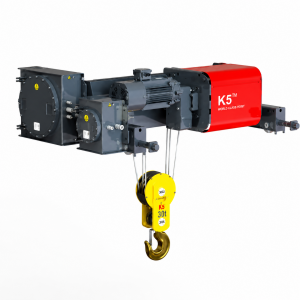
Generally, lower FEM classes are suitable for occasional and light-duty operations. In contrast, higher FEM classes are designed for frequent operation, heavier loads, and demanding industrial environments.
Here is how the standard FEM classes break down for wire rope hoists:
FEM 1Bm & 1Am: Light Duty
These classes typically handle occasional lifting tasks. Hoists in this range primarily move lighter materials and only infrequently lift their maximum rated capacity. Consequently, they serve well in maintenance workshops or low-frequency assembly stations where the equipment sits idle for most of the shift.
FEM 2m: Moderate Duty
This rating generally supports standard, everyday industrial use. A 2m hoist manages a mixed load spectrum, meaning it routinely alternates between medium loads and occasional maximum capacity lifts. Therefore, it is a common and reliable choice for general manufacturing production lines working a standard single shift.
FEM 3m: Heavy Duty
Hoists in this class are built for highly frequent operations. They routinely handle materials at or near their maximum rated capacity and endure longer motor running times. As a result, facilities operating across two or three continuous shifts typically require this rating to maintain equipment reliability.
FEM 4m: Severe Duty
This classification is designed for continuous duty cycles in severe environments. A 4m hoist consistently lifts maximum rated loads with very little downtime between mechanical cycles. Consequently, heavy industries like steel production or foundries usually rely on this rating to sustain continuous output.
Choosing the Right FEM Duty Class for Different Applications
Selecting the correct FEM rating requires matching your daily workflow to real-world industrial scenarios. By identifying your specific operational profile, you can quickly narrow down the appropriate duty class.
General Manufacturing
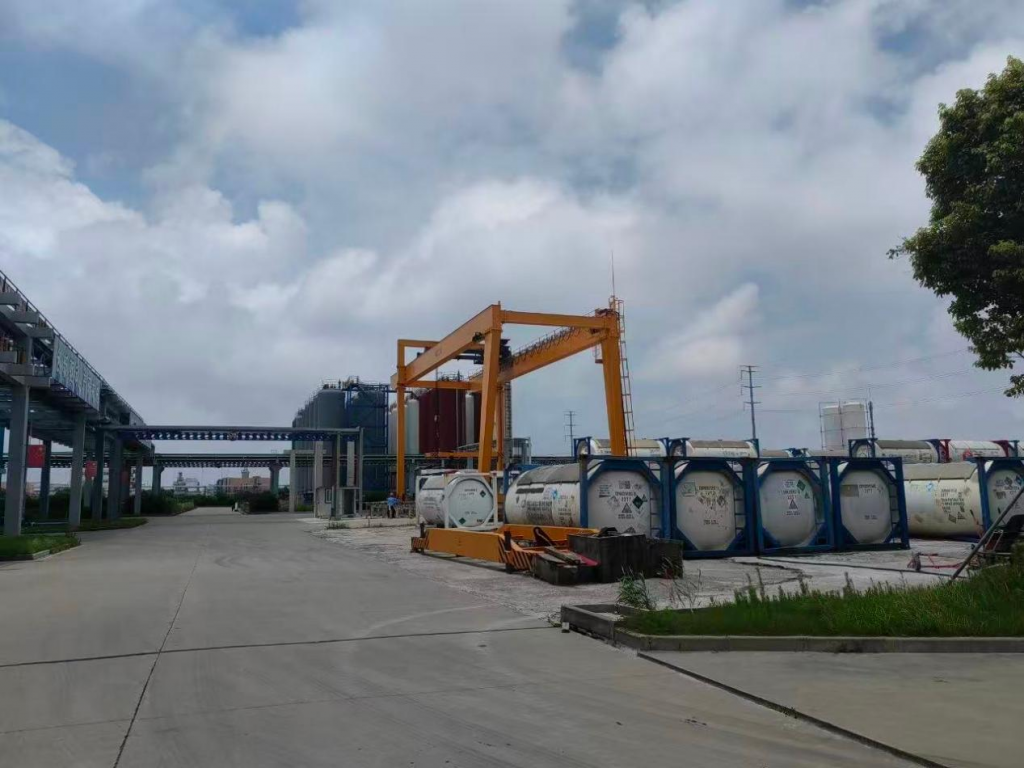
General manufacturing environments typically experience moderate operating frequencies with mixed load weights during a standard shift. Common applications include:
- Automotive assembly lines
- Distribution warehouses
- CNC machining centers
- Packaging facilities
- Light metal fabrication shops
- Routine maintenance workshops
Therefore, for these standard operations, a FEM 1Am or 2m hoist generally provides sufficient durability without unnecessary over-investment.
Heavy Industry
Heavy industrial applications often involve continuous high-load cycles, frequently running across multiple shifts. These demanding scenarios include:
- Steel production plants
- Metal foundries
- Concrete precast yards
- Shipbuilding drydocks
- Heavy equipment manufacturing lines
- Mining and mineral processing facilities
Consequently, these demanding environments typically require a FEM 3m or 4m rating to prevent mechanical fatigue and motor failure.
Hazardous and Chemical Industries
These sectors demand equipment with strict temperature control. An overworked hoist generates excess heat, which creates severe safety risks in explosive atmospheres. These critical environments include:
- Oil and gas refineries
- Chemical processing plants
- Pharmaceutical manufacturing facilities
- Paint and solvent production lines
- Agricultural grain handling facilities
- Petrochemical storage and loading zones
As a result, these specialized operations usually require specific FEM ratings paired directly with explosion-proof hoist designs to maintain strict thermal limits.
Recommended reading: Best ATEX-Certified Electric Hoists for Hazardous Environments
Why FEM Duty Class Matters for Explosion-Proof Hoists
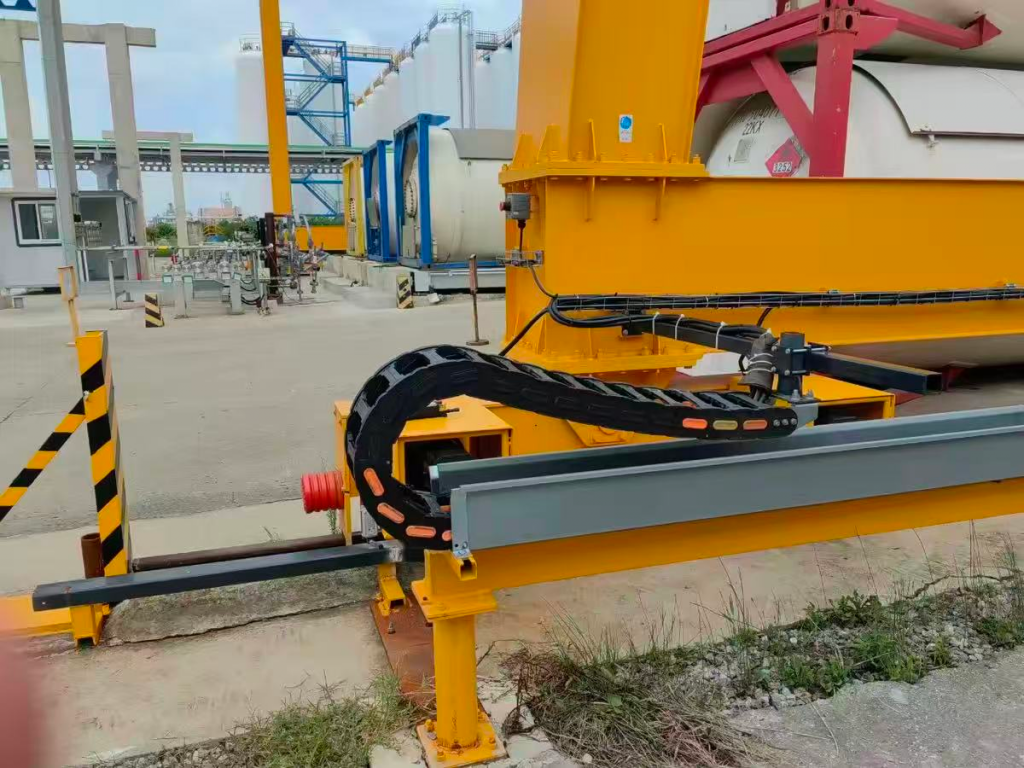
To operate safely in volatile areas, facilities use explosion-proof wire rope hoists to prevent sparks. However, a flameproof enclosure alone is not enough because the motor still generates heat. Therefore, matching the correct FEM duty class is a critical safety requirement to control this internal temperature.
Challenges in Hazardous Environments
Operating in combustible areas presents unique challenges when your hoist has the wrong FEM rating:
- Excessive motor heat:A hoist running beyond its rated duty class generates surface temperatures that can approach the ignition point of surrounding gases or dust.
- Accelerated component wear:Seals, bearings, and brake linings degrade faster, and the flameproof enclosure may no longer maintain its protective barrier.
- Unplanned downtime in restricted zones: Repairs in hazardous areas require additional safety permits, gas-free certifications, and specialized crews, significantly increasing costs.
Advantages of Explosion-Proof Wire Rope Hoists
When you combine a purpose-built explosion-proof hoist with the correct FEM rating, it directly resolves those challenges:
- Controlled thermal output: A properly rated hoist keeps surface temperatures below the maximum allowable level for the specific gas or dust group classification.
- Extended maintenance intervals: Seals and bearings retain their integrity longer because the motor and drivetrain run within their intended load and time parameters.
- Predictable service scheduling: Components wear at the expected rate, so maintenance teams can plan servicing during scheduled shutdowns rather than responding to unexpected failures.
5 Steps to Select the Right Hoist for Your Application
Selecting the appropriate lifting equipment requires a clear understanding of your facility’s daily workflow. Following a structured evaluation process helps you match the exact mechanical and safety requirements of your specific operation.
Step 1: Assess Your Load Spectrum
First, evaluate the specific weights your facility handles on a daily basis. Identifying the proportion of maximum capacity lifts versus lighter, routine loads helps determine the actual mechanical stress your equipment will endure.
Step 2: Calculate True Operating Time
Next, estimate the active running time of the hoist motor. Rather than counting the total hours in a work shift, tracking the exact time the equipment actively lifts and lowers materials provides a more accurate measure of thermal strain.
Step 3: Pinpoint the FEM Rating
With your load spectrum and active operating time defined, you can easily cross-reference these two metrics on a standard FEM chart. This direct calculation reveals the precise duty rating required to handle your specific workload without overworking the motor.
Step 4: Evaluate Environmental Hazards
After establishing your mechanical requirements, assess your physical workspace for combustible materials. If your operation involves flammable gases or dust, you typically need to pair your calculated FEM rating with an explosion-proof enclosure to safely manage ignition risks.
Step 5: Verify with the Manufacturer
Finally, share these specific operational details with a specialized lifting equipment manufacturer. Professional verification helps confirm that your selected FEM class and physical enclosure safely align with your facility’s demands before installation.
Built for Extremes: WORLDHOISTS Explosion-Proof Wire Rope Hoists
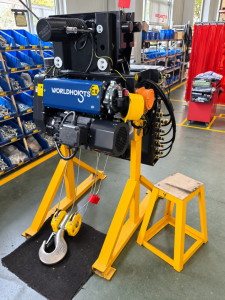
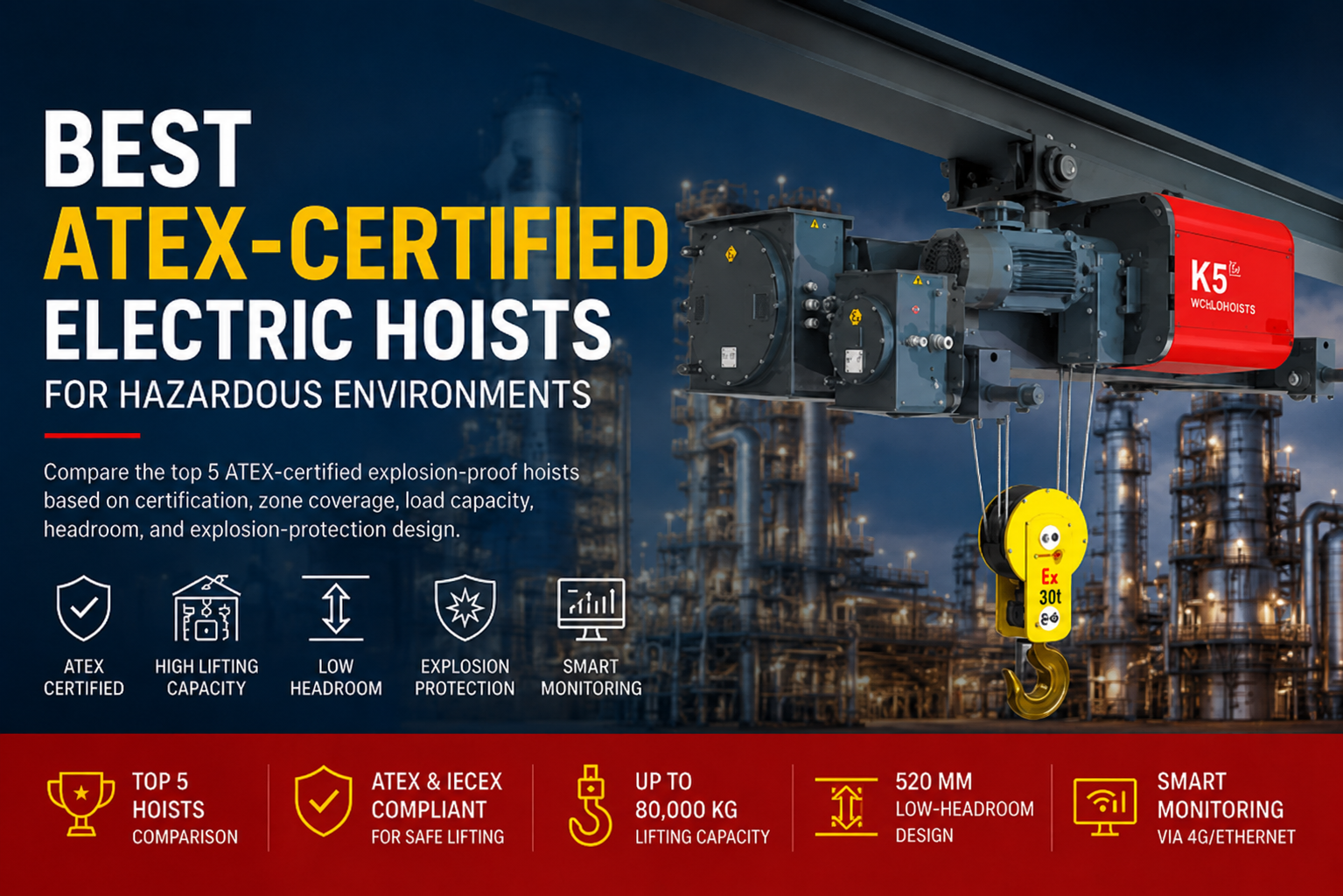
When your facility requires reliable lifting in hazardous zones, the WORLDHOISTS Explosion-Proof Wire Rope Hoist provides a specifically engineered solution. Designed for Zone 1 and Zone 2 environments, this equipment complies directly with ATEX, EN, IEC, and GB safety standards. Consequently, it serves demanding sectors like petrochemical plants, oil refineries, and power stations.
The equipment offers lifting capacities from 0.8 to 80 tons across M3 to M6 duty classes. To control thermal and electrical risks, a standard Ex d e IIB T4 rating, an IP66 enclosure, and spark-proof copper-plated hooks effectively isolate internal mechanics from combustible atmospheres.
Beyond physical protection, an integrated smart system monitors motor starts, overloads, and brake wear via 4G or Ethernet. Combined with a space-saving 520 mm low-headroom design, this equipment ensures safe, continuous operations when matched with your specific duty requirements.
Ensure Safe Lifts in Volatile Environments
Selecting the appropriate FEM duty class goes beyond mechanical durability; it serves as a critical temperature control strategy for explosion-proof hoists. Properly matching your equipment to its actual workload prevents hazardous motor overheating. Protect your facility and maintain efficient production by choosing a hoist engineered for your specific demands. Contact WORLDHOISTS today to explore advanced explosion-proof solutions and configure the right lifting equipment for your operational needs.