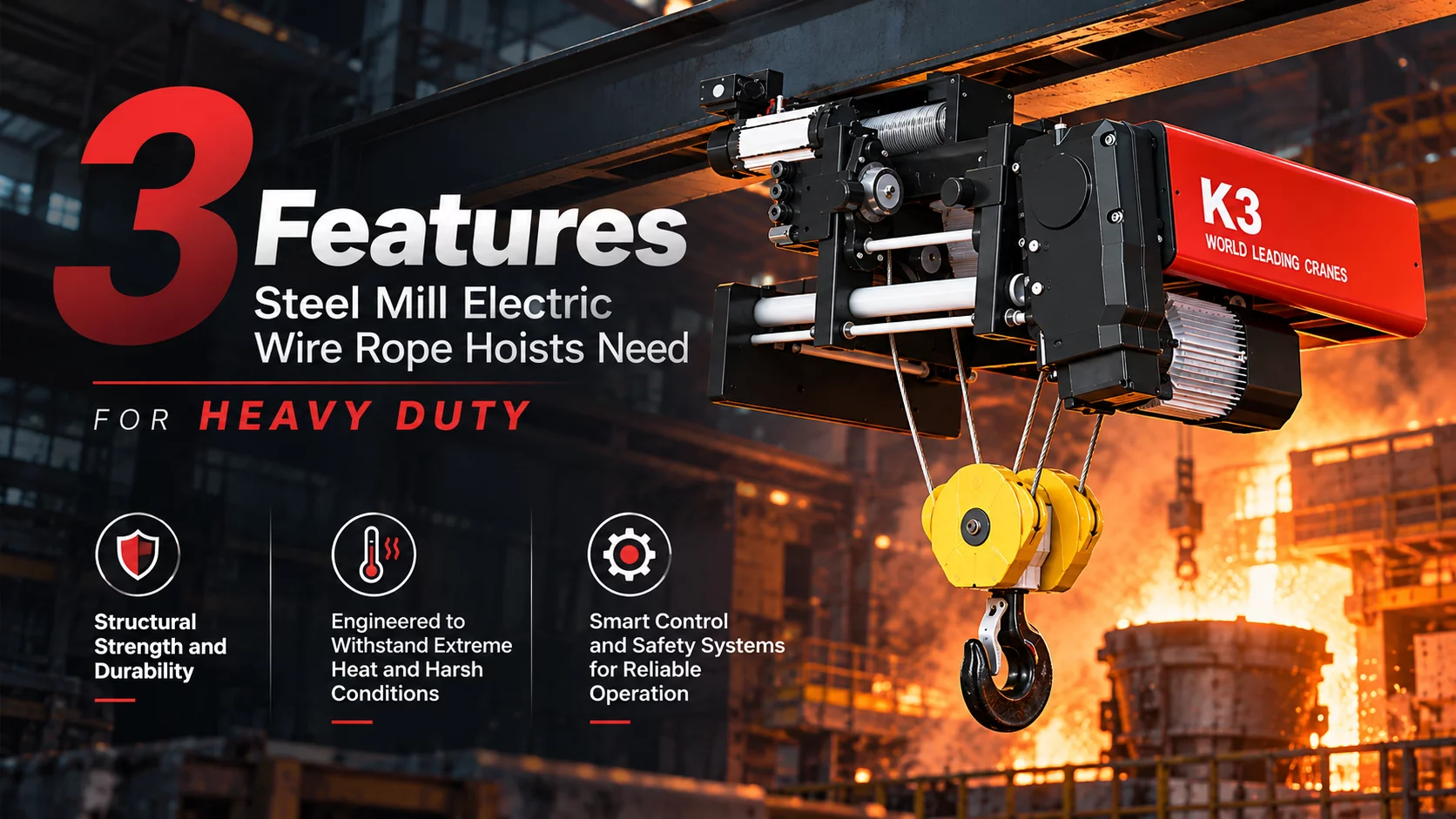
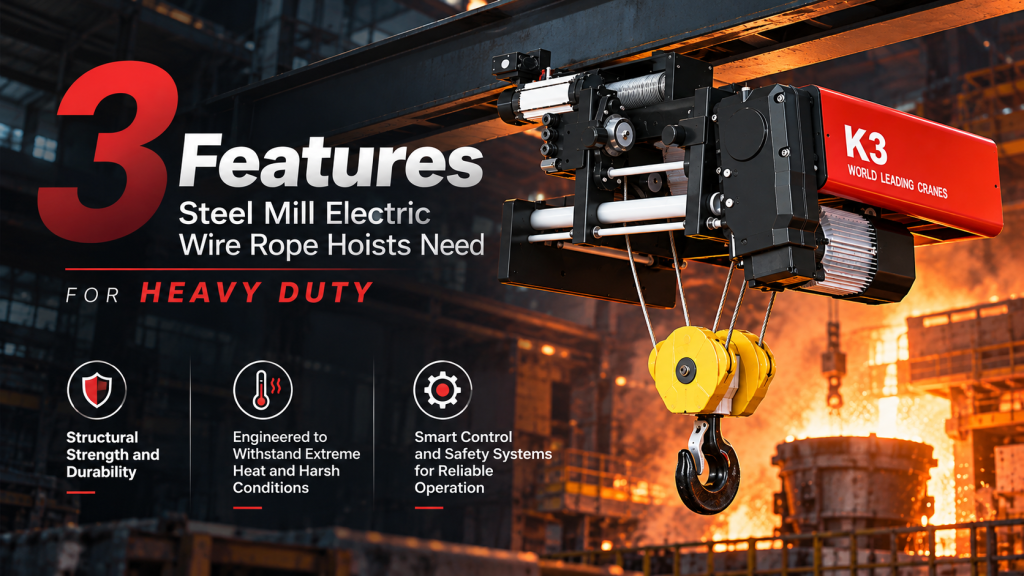
Steel mills are among the most demanding environments for lifting equipment. Extreme heat, heavy dust, and round-the-clock operation push standard wire rope hoists beyond their limits, leading to frequent breakdowns, costly downtime, and serious safety risks. To keep production running safely and efficiently, electric wire rope hoists used in steel mills must deliver in three key areas: structural durability, extreme environment protection, and smart control with safety systems.
Why Steel Mills Demand More from Wire Rope Hoists
Steel mill electric wire rope hoists must handle environmental and operational loads at the same time. Radiant heat, metallic dust, abrasive mill scale, moisture, and multi-shift production increase component temperatures, restrict motor cooling, contaminate electrical and moving parts, and accelerate wear.
Heavy-duty suitability is therefore determined by the complete operating profile. The load spectrum, lifting cycles, starts per hour, motor operating time, lifting distance, ambient and radiant temperatures, and the impact of equipment downtime must all be considered when selecting the duty class.
Together, these conditions determine the hoist’s thermal design, component strength, protection level, and maintenance schedule. They also explain why steel mill hoists need three connected features: a durable load path, protection against heat and contaminants, and control and safety systems that maintain stable lifting.
Feature 1 – Structural Strength and Durability for Heavy-Duty Lifting
The first required feature is a structure that preserves one stable load path through repeated lifting cycles. The frame, transmission, rope system, and load-holding devices must carry the same duty rating and remain aligned under impact, vibration, and temperature changes.
Reinforced Core Components
Maintaining that load path requires every core component to support the same load spectrum. High-strength welded frames provide stiffness, while hardened gears and load-rated bearings keep the drum and transmission aligned during frequent lifting.
The rope and drum must provide the same structural stability. An independent wire rope core supports the strands during heating and repeated bending, while drum grooves reaching approximately 40 percent of the rope diameter keep the rope seated and guide controlled winding. Together, these components distribute lifting forces evenly through the hoist.
Redundant Safety Protection Systems
A reinforced load path carries the expected load; redundant protection keeps it controlled when the hoist reaches a travel or load limit. For hot-metal handling, two holding brakes provide independent load-holding paths.
A drum-driven geared limit switch controls normal hook travel. An independent upper limit and lower-travel or slack-rope devices add further operating boundaries.
Structural design factors complete this protection. Standard load-bearing components may use factors of 5:1 or 6:1, while hooks, wire ropes, and bottom blocks for molten-material handling may reach 10:1 based on ultimate strength.
Feature 2 – Engineered to Withstand Extreme Heat and Harsh Conditions
Structural strength remains effective when motors, brakes, and electrical equipment operate within their specified temperature and exposure limits. The second required feature is therefore protection against internally generated heat, radiant heat, conductive dust, and moisture.
Heat-Resistant Motor and Brake Design
Frequent starts, long lifting cycles, and low-speed positioning increase the thermal load on the motor and brake. Maintaining lifting and braking performance therefore requires insulation, cooling, and braking capacity matched to the operating cycle.
Class H motor insulation provides a thermal classification of 180°C, while thermal derating matches motor output to ambient temperature and duty cycle. Embedded thermistors or bimetallic switches protect the windings, and a separately powered fan maintains cooling airflow during extended low-speed operation.
The brake must handle the same repeated thermal load. An enclosed disc brake with heat-resistant linings maintains braking performance across repeated stops, while demanding applications may use braking torque rated at 200 percent of motor torque.
High Protection Rating Against Dust and Moisture
Managing motor and brake temperature controls internal heat. Sealed enclosures and thermal barriers then protect the same components from external exposure.
IP65 or IP66 enclosures protect motors, brakes, limit switches, and control panels in areas containing metallic dust or moisture. Reflective shields beneath the hoist or crane girders reduce radiant heat from furnaces and molten material.
Control cabinets positioned away from direct heat can use insulation, filtered ventilation, or internal cooling. These measures keep electrical and control components within suitable operating conditions.
Feature 3 – Smart Control and Safety Systems for Reliable Operation
Structural and environmental protection prepare the hoist for steel mill service, while intelligent control manages the load during every movement. The third required feature is a control and monitoring system that connects precise motion, load protection, and maintenance data.
Advanced Control Systems for Precision Lifting
Heavy steel loads require controlled acceleration, low-speed movement, and accurate placement. The control system must therefore match the required speed range, minimum stable speed, low-speed torque, and positioning accuracy.
For micro-positioning, a speed range of 10:1 or wider, encoder feedback, and closed-loop vector control support stable torque and accurate low-speed movement. Active sway control further limits suspended-load movement along the lifting route.
Slack-rope or snag detection responds to unexpected changes in rope tension. During tandem lifting, synchronized control coordinates the speed and position of multiple hoists. Each function addresses a defined movement risk within the lifting task.
Real-Time Monitoring and Overload Protection
Motion control protects each movement, while real-time monitoring protects the hoist across repeated cycles. Electronic overload protection uses load cells or indirect power measurement to compare the lifted load with rated capacity.
When the load reaches approximately 105 percent to 110 percent of rated capacity, the system interrupts upward motion. This keeps lifting forces within the preset protection range.
Condition monitoring records operating hours, start and stop counts, drive temperature, overload events, and fault history. Analysis of accumulated load data and operating cycles then supports service-life assessment and maintenance scheduling, connecting immediate load protection with long-term reliability.
Note: The numerical values in this article are general engineering references. Final parameters should be confirmed according to the applicable standards, operating conditions, and project requirements.
WORLDHOISTS Wire Rope Hoists – Built for the Toughest Steel Mill Applications
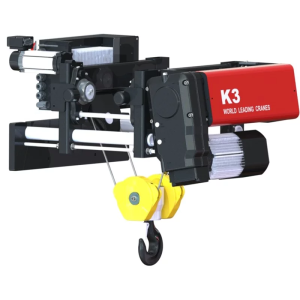
These three heavy-duty requirements deliver the greatest value when they are specified as one coordinated system. WORLDHOISTS K Series and H Series wire rope hoists cover duty classes M4 to M6, a 60 percent motor duty cycle, lifting capacities from 0.8 to 80 tonnes, and lifting heights up to 90 metres.
For structural performance, the hoists combine 2160 N/mm² galvanized wire rope, a hardened gear reducer, and a large rope drum. These features support stable power transmission, controlled rope winding, and longer wire rope service life.
For environmental resistance, standard configurations include Class H insulation, IP55 protection, and an epoxy zinc-rich coating. Metallurgy, extreme-temperature, and anti-corrosion configurations are available for project-specific conditions.
Overheat, overload, and fall protection support safe operation, while optional sway control, inching, micro-speed control, smart monitoring, remote control, and automation allow the control system to match the lifting task.
Together, these standard specifications and configurable options allow WORLDHOISTS to match each wire rope hoist to the steel mill’s actual load, duty cycle, environmental conditions, and control requirements.
Three Features, One Reliable Steel Mill Hoist
Reliable steel mill lifting depends on three connected choices: a reinforced load path, protection matched to heat and contaminants, and controls that manage motion and operating data. WORLDHOISTS supports these requirements with M4 to M6 wire rope hoists and project-specific configurations for metallurgy and demanding environments. Share your load capacity, lifting height, duty class, temperature, and control requirements with WORLDHOISTS to configure the right hoist for your steel mill.
FAQs
What duty class (FEM/ISO) should a wire rope hoist have for steel mill use?
The right duty class depends on the lifting frequency, load weight, and operating hours of your specific application. For most steel mill operations, a minimum of M4 or higher is recommended to ensure long service life under demanding conditions.
WORLDHOISTS wire rope hoists are available from M4 to M6, covering a wide range of steel mill lifting scenarios. For applications requiring higher specifications, WORLDHOISTS also offers customized solutions tailored to your project needs.
How often should wire rope hoists in steel mills be inspected?
In steel mill environments, daily visual checks and weekly functional inspections are recommended due to the extreme operating conditions. Key inspection items include the wire rope, hook, drum, brakes, and limit switches. WORLDHOISTS wire rope hoists support smart monitoring and remote diagnostics as optional configurations, helping operators detect potential issues early and reduce unplanned downtime.
Can standard wire rope hoists be retrofitted for high-temperature environments?
Standard wire rope hoists are not designed for the extreme heat found in steel mills. High-temperature environments require purpose-built solutions with heat-resistant insulation, specialized motors, and high-temperature lubricants to ensure safe and reliable operation. WORLDHOISTS offers wire rope hoists with metallurgy-grade configurations, specifically adapted for extreme temperatures, anti-corrosion, and other harsh conditions in steel plants.
References
[1] https://www.biey.com/cranes/5232.html
[2] https://konex.co.in/which-type-of-crane-is-used-in-the-steel-industry/
[3]https://www.nantecrane.com/news/high-temperature-overhead-crane-design-guide-for-steel-mills/