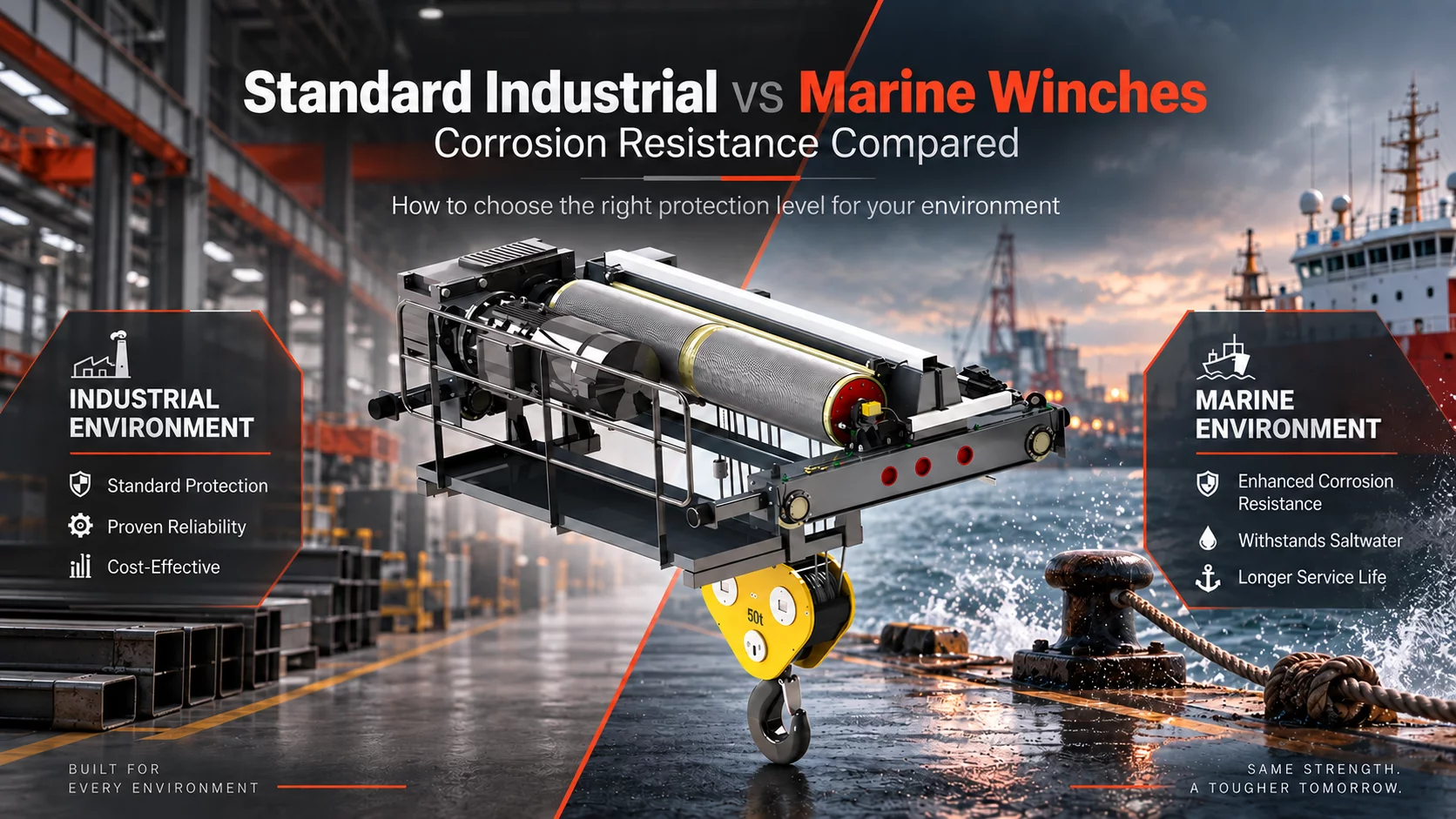
Not every lifting operation requires the same level of corrosion protection. Over-specifying drives up costs unnecessarily; under-specifying risks premature equipment failure. Matching the right protection level to your actual environment is the real challenge.
In this article, we compare standard industrial and marine winches head-to-head, explore their structural differences in corrosion resistance, and provide practical selection guidelines for your facility.
What is a Standard Industrial Winch?
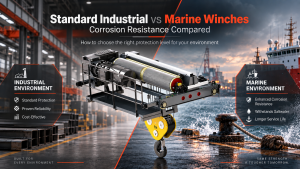
A standard industrial winch is engineered specifically for non-saline terrestrial worksites. Manufacturers utilize standard metal alloys and traditional paint systems instead of expensive marine barriers. Consequently, this design provides reliable lifting force for inland environments without the heavy cost premium.
Important Functions: Hauling construction materials, pulling heavy machinery, and positioning structural components across land-based facilities.
Advantages
- High cost-effectiveness for general applications due to the use of standard industrial manufacturing materials.
- Fast and simplified maintenance supported by universally accessible standard replacement parts.
- Broad operational adaptability for general indoor manufacturing and covered terrestrial worksites.
Limitations
- High vulnerability to accelerated rust and structural damage when exposed to continuous moisture or corrosive chemicals.
- Inadequate environmental sealing for operations involving heavy water exposure or severe outdoor weather conditions.
What is a Marine Winch?
In direct contrast to standard industrial equipment, a marine winch is a specialized lifting device designed specifically for saltwater environments. Manufacturers construct these devices using heavy-duty anti-corrosion materials to prevent chemical degradation. Therefore, this equipment maintains structural integrity even when constantly exposed to harsh ocean conditions.
Important Functions: Managing heavy loads during coastal operations, anchoring commercial vessels, and positioning offshore platforms.
Advantages
- Superior resistance to rust and chemical degradation in harsh,corrosive environments.
- High-level environmental sealing to prevent water and salt from damaging internal electrical components.
- Extended operational lifespan under continuous exposure to extreme maritime weather conditions.
Limitations
- Significantly higher initial purchase cost due to specialized anti-corrosion materials and sealing systems.
- Complex maintenance procedures requiring specialized technicians and specific marine-grade replacement parts.
Industrial Winches vs. Marine: A Head-to-Head Corrosion Resistance Comparison
Evaluating corrosion resistance requires inspecting specific equipment components. Understanding how different structural parts are designed for their intended environments helps buyers select the most cost-effective solution for their facility.
The following criteria break down these key components and explain their practical relevance.
Core Body Material
The core body material serves as the primary metal framework for the winch base and drum. Understanding this specification helps buyers estimate the expected service life of the equipment under their specific operating conditions.
Surface Treatment
Surface treatment involves applying protective chemical layers or paint over the bare metal to manage environmental exposure. Evaluating the coating type and layering structure helps buyers select the most cost-effective protection level for their actual worksite conditions.
Internal Sealing
Internal sealing utilizes physical barriers and gaskets designed to shield sensitive motors, brakes, and electrical connections. Evaluating the sealing grade helps buyers match protection to their site’s moisture level, avoiding both unnecessary cost from over-rated enclosures and operational risk from under-rated ones.
The Pulling Cable/Rope
This component functions as the active lifting medium, utilizing woven wire strands or synthetic fibers to handle heavy loads. Selecting the appropriate rope material for your site conditions helps ensure safe lifting operations and optimal rope service life.
Fasteners and Joints
Fasteners represent the structural bolts, nuts, and connecting points that hold the winch assembly together. Inspecting these components helps buyers identify whether the hardware grade matches their environment, as moisture tends to accumulate in these small crevices first.
Corrosion Resistance Comparison Table
Comparison Criteria | Standard Industrial Winch Standard | Marine Winch Standard |
Core Body Material | Carbon steel and conventional alloys optimized for terrestrial operations. | Marine-grade anti-corrosion alloys designed for saltwater environments. |
Surface Treatment | Industrial paint or powder coating suited for dry and covered worksites. | Multi-layer marine epoxy with chemical sealants for continuous salt exposure. |
Internal Sealing | Standard sealing rated for dust and moderate ambient moisture. | High-grade sealing rated for direct water and salt spray exposure. |
The Pulling Cable/Rope | High-strength galvanized carbon steel wire rope for general industrial use. | Stainless steel wire rope or treated synthetic marine fibers for saltwater resistance. |
Fasteners & Joints | Zinc-plated or standard steel hardware for non-saline environments. | Stainless steel hardware with anti-seize treatment for saltwater joint protection. |
Analysis and Insights: Strategic Takeaways for Winch Selection
The structural comparison above provides a clear foundation for equipment selection. Facility managers can apply these four corrosion-focused rules to determine which winch matches their specific site conditions.
Selection Rule 1: Look Beyond Surface Paint
Effective corrosion defense depends on the chemical layering structure beneath the surface — not on the visible topcoat alone.
When evaluating equipment, request the full coating specification rather than relying on visual inspection. Identify how many protective layers are applied, what chemical function each layer serves, and whether the system provides secondary defense if the outer surface is damaged.
The right coating complexity should correspond directly to the severity of your site’s environmental exposure.
Selection Rule 2: Match the Rope and Fasteners to the Corrosion Risk
Corrosion attacks every load-path component, not just the winch body. Cables, fasteners, and joints often fail first because they combine high mechanical stress with direct environmental exposure.
Verify that the rope material and fastener grade are specified for the actual conditions they will face — not just the winch body’s rating. Pay particular attention to crevice points where moisture tends to accumulate, as these are typically the first areas to show corrosion damage.
Selection Rule 3: Assess Your Corrosion Environment Accurately
Misidentifying your site’s corrosion severity leads to either unnecessary spending on over-engineered protection or premature equipment failure.
Before selecting equipment, classify your operating environment based on verified data: moisture levels, salt concentration, chemical exposure, and wet-dry cycling frequency. This classification directly determines the appropriate material grade, coating system, and sealing level for every component.
Selection Rule 4: Use Targeted Upgrades for Middle-Ground Environments
Not every site falls neatly into a “dry indoor” or “full saltwater” category. Outdoor terrestrial sites — such as uncovered yards, humid ports, or tropical facilities — sit between these extremes.
For these middle-ground environments, apply targeted anti-corrosion upgrades to specific components: higher-rated enclosures for rain exposure, heavy-duty topcoats for intermittent water contact, and upgraded fasteners at exposed joints.
This component-level approach delivers protection precisely calibrated to your actual environmental threats without unnecessary cost.
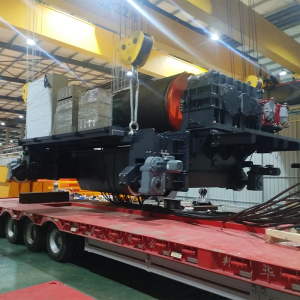
Key Applications for Marine and Standard Industrial Winches
Understanding which environments each winch type is designed for helps reinforce the selection rules above. The following scenarios illustrate typical deployment conditions for both categories.
Marine Winch Scenarios:
- Commercial shipyard dry docks and slipways.
- Offshore oil and gas platforms.
- Coastal port loading facilities and dockside cranes.
- Oceanographic research vessels and commercial fishing boats.
Standard Industrial Winch Scenarios:
- Inland commercial construction sites.
- Manufacturing plant assembly lines.
- Non-corrosive underground mining operations.
- Forestry and terrestrial logging yards.
Reliable Lifting Solutions: WORLDHOISTS Heavy-Duty Industrial Winches
Selecting the right industrial winch starts with matching the equipment’s baseline protection to your actual site conditions. WORLDHOISTS heavy-duty industrial winches are engineered for high-load lifting, pulling, and positioning across demanding terrestrial and industrial environments. Core advantages include:
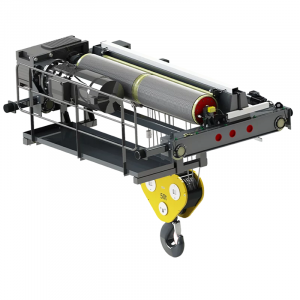
- Wide load range: Lifting capacities from 5t to 500t with maximum lifting heights up to 160m.
- Premium components: Key parts adopt European design principles, sourced from internationally recognized brands including SEW, Siemens Flender, and Nord.
- Dual braking system: Ensures secure load holding even in emergency conditions.
- Built-in self-diagnosis: Real-time fault detection for precise and safe operation.
- IP55 protection as standard: Industrial-grade sealing against dust and water ingress.
For facilities operating in higher-corrosion or special environments, WORLDHOISTS offers customizable configurations to bridge the gap between standard industrial and full marine-grade protection:
- Explosion-proof and special environment options: Available configurations for high-temperature, high-humidity, and extreme cold conditions.
- Customizable specifications: Drum size, rope length, lifting speed, and control mode can be tailored to match specific site requirements.
WORLDHOISTS winches are widely used in metallurgy, energy, shipbuilding, mining, and heavy manufacturing industries — delivering stable performance, long service life, and maximum operational safety across a broad range of industrial applications.
Choose the Right Protection — Not the Most Expensive One
Corrosion resistance is not one-size-fits-all. Standard industrial winches deliver reliable performance for terrestrial operations; marine winches serve extreme saltwater exposure — and targeted upgrades can bridge the gap for middle-ground environments.
WORLDHOISTS heavy-duty industrial winches combine premium components, intelligent safety systems, and customizable configurations to match your exact site conditions.
Request a free quote today and let our engineers recommend the right winch specification for your facility.
FAQs
Q: Are highly corrosion-resistant winches completely maintenance-free?
While harsh environments demand durability, WORLDHOISTS minimizes your downtime with advanced, low-maintenance engineering. Featuring a built-in Centralized Lubrication System and heavy-duty coatings, our winches deliver reliable operation in high-humidity conditions without the constant need for manual greasing.
Q: Is it worth buying a marine winch for an inland facility just to get better corrosion resistance?
Rarely. Marine winches carry a high price premium specifically for saltwater exposure. For high-humidity inland operations, this is an unnecessary investment. Instead, WORLDHOISTSs customizes heavy-duty industrial winches with robust corrosion-resistant coatings, IP55 protection, and Class H insulation—delivering reliable environmental defense without the maritime markup.
Q: Should I use synthetic rope to avoid rust entirely?
Synthetic ropes resist rust but often lack the extreme abrasion resistance required for heavy industry. WORLDHOISTS balances safety and weather resistance by equipping winches with premium 2160N/mm² High-Strength Galvanized Wire Rope. Paired with our specialized Rope Guide to prevent tangling, this setup extends both the lifespan and anti-corrosion performance of the cable.