Safely managing heavy loads in industrial environments depends on the integrity of below‑the‑hook connections. Daily manufacturing and warehousing tasks subject lifting hooks to intense stress and repetitive strain, making the choice of attachment – whether single hooks, duplex hooks, safety latches, or swivel assemblies – critical for preventing accidental load slips and unbalanced lifts. Our team at World Hoist helps industrial businesses select the most reliable connection mechanisms tailored to their specific lifting needs, ensuring both fast operation and long‑term security.
Understanding how physical forces distribute across a lifting point allows operations to avoid early component wear and detect structural fatigue before it becomes hazardous. When hooks are chosen and inspected correctly – with regular checks for throat widening, saddle wear, and hidden cracks – facilities gain smoother workflows, fewer bottlenecks, and reduced unplanned downtime. We at World Hoist focus on delivering highly reliable structural solutions, from individual attachments to complete crane kits, and support your team with clear maintenance procedures that keep material handling configurations performing exactly as planned.
Selection Criteria for Hook Designs
Single Hooks: These components are designed with a basic curved body that excels in standard rigging and lifting setups. They provide a clear connection point for slings and shackle assemblies during quick plant moves.
Duplex Hooks: Featuring a symmetrical two-prong structure, these devices distribute heavier loads evenly across the hook body. This design prevents unbalanced center-of-gravity shifts during complex crane moves.
Safety Latches: Vital spring-loaded metal flaps that cover the throat of the hook to block rigging slips. These devices must be inspected daily to make sure they snap back into place correctly under tension.
Swivel Assemblies: Integrated bearings allow the hook to rotate freely under load, preventing wire ropes from twisting. This rotation protects the hoisting lines from severe torsional strain.
Safe Connection and Manipulation Procedures
Rigging crews must follow strict guidelines to verify that heavy loads are balanced before raising the hoist. Incorrect hook positioning can cause the rigging to sit on the tip of the hook rather than in the saddle, which can bend the steel. Mastering safe hook attachment handling techniques prevents dangerous load shifts during initial lifting movements.
Protecting these load points from lateral impacts keeps the forged steel structure from developing micro-cracks. When lifting unbalanced loads, utilizing spreader bars helps keep the hook vertical and aligned. At World Hoist, we prioritize educating teams on these physical dynamics to support accident-free facility operations.
Identifying Physical Wear and Cracks
Continuous stress from daily production runs gradually creates micro-deformations in even the strongest forged steel. Regular inspections are critical to monitor hook throat openings, as any widening beyond original dimensions indicates structural fatigue. Planning a timely hoist hook replacement is necessary when physical inspection measurements reveal structural compromises.
Engineers use specialized dye penetrant tests to locate hidden cracks that are invisible to the naked eye. Checking the physical wear on the hook saddle prevents sudden failures where the load rests during travel. Removing damaged lifting components immediately keeps your plant compliant with international safety mandates.
Step-by-Step Maintenance and Swapping
Replacing a worn hook requires a systematic approach to secure the new assembly correctly onto the hoist. Technicians must completely disassemble the bottom block, replacing worn thrust bearings, pins, and sheave guards simultaneously. Completing a professional overhead crane hook change prevents future mechanical binds within the bottom block assembly.
Testing the new assembly under controlled load conditions is essential before returning the crane to normal service. This practice confirms that the swivel turns smoothly and the safety latch functions reliably under tension. Our technical support team at World Hoist provides clear guidelines to simplify these maintenance procedures for your crew.
Designing Complete Lifting Configuration Systems
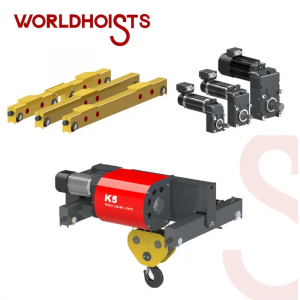
Integrating modular parts into your facility layout simplifies long-term maintenance and speeds up on-site assembly. Utilizing complete Crane Kits & Lifting Attachments ensures that all hoist components, electrical systems, and structural end trucks are fully compatible from day one. This structural compatibility reduces vibration and prevents early wear on sensitive connection points.
To streamline your planning stage, we utilize our proprietary King software on the VB platform. This program generates exact calculation sheets and drawings in five minutes, helping teams choose the right components quickly. Selecting pre-matched hoist kits minimizes installation errors and shortens on-site construction times dramatically.
Environmental Protections for Harsh Areas
Chemical processing facilities and outdoor yards expose lifting hardware to corrosive moisture and acidic atmospheres. Standard steel components can rust quickly, which accelerates the deterioration of safety latches and bearings. Using specialized coatings or opting for stainless steel alloys protects hooks from fast environmental degradation.
We also modify heavy-duty assemblies to operate safely in hazardous, volatile industrial spaces. Using spark-resistant copper-alloy coatings on hooks prevents friction sparks in areas containing flammable gases or vapors. Our engineering group designs custom, heavy-duty attachments to keep your personnel safe in extreme operating environments.
Conclusion
Maximizing the service life of below-the-hook equipment requires a solid balance of correct selection, safe handling, and timely replacement. Prioritizing regular crane hook attachment inspections ensure that the connection points of your machinery remain secure under load.
Our team at World Hoist remains dedicated to offering premium Crane Kits & Lifting Attachments to support safe global lifting operations. By committing to proactive hoist hook replacement routines and executing precise overhead crane hook change processes, facilities can secure long-term productivity and keep their workers protected.