Handling long, asymmetrical, or extremely heavy industrial structures requires a lifting approach that moves beyond standard single-hook configurations. Utilizing a synchronized crane lifting strategy prevents dangerous load tilts and structural bending by distributing the total weight across multiple hoisting points simultaneously. Our engineering group at World Hoist works with heavy manufacturing facilities to deploy these advanced dual-drive systems, ensuring that even the most complex lifts proceed with full stability.
Relying on a single pick point for long steel pipes or wind turbine blades can cause the load to spin or slide out of its rigging. Transitioning to integrated multi-hook systems solves these physical load-balancing challenges on the active production floor. We focus on providing detailed technical insights to help industrial teams manage their heavy-volume lifting projects safely and predictably.
Understanding Multi-Point Lifting Dynamics
Suspending an elongated structural load from two separate hook points requires continuous real-time coordination between both hoisting drums. If one hoist raises its hook even slightly faster than the other, the load will tilt, transferring the weight to a single side. This sudden weight shift can overload individual cables and lead to catastrophic structural failure of the rigging.
A dual-drive system must actively monitor and correct these tiny vertical speed variances during every phase of the lift. By maintaining a level plane, the machinery prevents horizontal sliding forces from pulling the rigging lines out of alignment. Understanding these physical balancing forces is crucial for keeping your lifting paths stable and your operators safe.
Comparing Dual Trolley and Auxiliary Hook Layouts
Dual Trolley Configurations: Two independent hoists ride on separate trolleys along the same bridge girder, offering maximum flexibility in hook-to-hook distance.
Auxiliary Hook Systems: A single trolley carries a main high-capacity hoist alongside a smaller, faster auxiliary hoist for handling lighter, secondary lifting tasks.
Selecting a dedicated dual hook overhead crane setup allows facilities to handle long wind tower sections or heavy casting molds with great stability. This dual-hoist design allows operators to lift, level, and rotate massive components smoothly in mid-air. At our company, World Hoist, we help factories configure these flexible trolley layouts to match their specific building clearances and load profiles.
Technical Execution of Tandem Lifting
Master-Slave Control Loops: Electronic control systems link both hoist motors, forcing the slave unit to mirror the exact speed and position of the master unit.
Load Cell Coordination: Digital weight sensors continuously compare the tension on both hooks, automatically pausing travel if an imbalance is detected.
Implementing a tandem lifting solution allows two cranes to handle loads that cannot be safely lifted by a single crane, provided the lifting plan and load distribution are properly designed. This digital synchronization helps maintain coordinated crane movement and reduces uneven loading during tandem lifting. Utilizing these advanced electronic links replaces manual signaling with precise, automated speed control.
Sourcing Premium Components for Heavy Winches
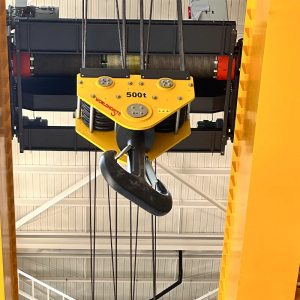
Running intensive dual-hook operations requires utilizing high-quality crane components that deliver reliable, long-term performance under heavy physical strain. Our heavy-duty industrial winches utilize a modular design built with premium parts sourced to the highest global engineering standards. Key mechanical elements adopt European design principles and are supplied by renowned international brands, including SEW, Siemens Flender, and Nord.
The high-performance hoisting motor provides steady, efficient driving power, while the robust hoisting gearbox reduces motor speed to increase output torque safely. From heavy-duty drums and high-tensile wire ropes to reliable limit switches and hook assemblies, every part is built to ensure long service life. Selecting these premium, pre-tested parts keeps your dual-winch systems performing predictably under demanding conditions.
Mechanics of Leveling and Tilting Control
Handling curved or unbalanced components like ship hulls requires a two hook crane system that can intentionally tilt the load under full control. Operators can adjust the relative speed of each hoist to angle the component perfectly for assembly on the welding deck. This controlled adjustment allows for fast, automated positioning without requiring manual rigging changes on the ground.
Zero-Speed Brake Holding: Holding the load securely in place while the electronic system recalculates weight distribution before a tilt.
Inching Control: Making tiny, millimeter-level vertical adjustments to align bolt holes perfectly during final structural mating.
Using a precise two hook crane system prevents sudden drops or jerks as the load transitions between different physical angles. This smooth movement protects the internal gears of the hoist from shock loads and prevents the wire ropes from fraying early. Our technical specialists assist facilities in setting up these flexible control curves for custom assembly tasks.
Electronic Safety Barriers in Synchronized Travel
Operating active tandem systems requires continuous monitoring of horizontal travel speeds to prevent structural binding. If one crane bridge travels faster than its partner along the runway rails, the bridge structures can experience severe torsional stress.
Integrated zone protection sensors prevent the hooks from colliding with each other or striking nearby facility walls during busy shifts. If a sensor detects an unexpected physical obstruction, the safety controller instantly pauses all vertical and horizontal movement. Maintaining these active electronic safeguards protects your investment and keeps your plant fully compliant with international safety standards.
Conclusion
Successfully handling heavy, elongated loads requires a smart combination of robust winches and responsive, electronic synchronization controls. Utilizing advanced synchronized crane lifting systems prevents structural fatigue in your building columns and protects your workforce from hazardous load tilts.
At our team, we focus on providing high-capacity dual-hook setups and durable travel drives to support your complex manufacturing layouts. By defining the right lifting path and investing in a reliable dual hook overhead crane or a custom tandem lifting crane solution, businesses can secure a safe, efficient, and highly productive operational future.