Mining sites push lifting and pulling equipment to its limits — continuous duty cycles, abrasive dust, high humidity, and zero tolerance for equipment failure. Choosing the wrong industrial winch doesn’t just hurt efficiency; it can lead to unplanned downtime, safety incidents, and costly replacements. This guide walks through the key factors that matter most when selecting a mining industrial winch, and how to match the right unit to your specific operation.
Why Mining Applications Demand a Different Winch Standard
Mining applications demand stricter performance, environmental protection, and safety standards than routine industrial lifting. A mining industrial winch must withstand frequent operation, harsh site conditions, and high-risk loads while minimizing equipment failure and downtime.
Continuous and High-Frequency Duty Cycles
Mining winches often operate repeatedly or for extended periods, especially in shaft hoisting and material haulage. Therefore, they require a duty rating that matches the actual operating frequency and running time, rather than being selected by load capacity alone.
Harsh and Hazardous Working Conditions
Mining sites expose winches to abrasive dust, moisture, vibration, mud, and temperature changes. Underground operations may also involve high humidity and restricted ventilation. For this reason, mining winches require stronger environmental protection than equipment used in controlled industrial settings.
Remote Sites with Strict Compliance Requirements
Mining sites are often located far from service centers, so equipment failure can lead to long delays. A mining industrial winch should therefore be easy to maintain and supported by readily available spare parts.
In addition, the winch must meet applicable lifting, electrical, braking, and mining safety requirements. These conditions make correct winch selection essential for reliable and safe operation.
What to Look for in a Mining Industrial Winch
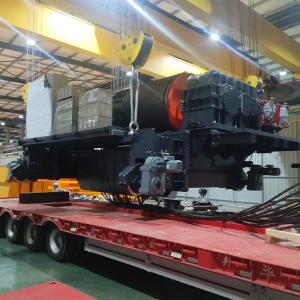
Rated load capacity alone isn’t enough. What matters is whether the winch matches the actual duty cycle, rope travel, operating environment, control accuracy, safety risks, and maintenance conditions of the application. The following eight factors outline what to verify before selecting a standard or customized unit.
1. Load capacity and duty cycle
Rated load and duty cycle must be checked together, not separately. A winch with sufficient pulling force can still fail if its duty rating doesn’t match how often it runs.
The key question is how long and how often the winch runs without stopping. Shaft hoisting cages move up and down repeatedly across a shift, leaving little time to cool, so it calls for continuous-duty operation. Haulage tasks pull, then pause while loading or unloading, so intermittent duty is usually sufficient.
Calculate the actual cycle frequency for the task, and match the duty rating to that data rather than to the load figure alone.
2. Wire Rope & Drum Specifications
Rope grade, diameter, and construction should match the material being handled. Abrasive ore wears rope faster than general industrial lifting, so mining applications need higher tensile strength and abrasion resistance, sized to the actual load.
Drum groove design needs equal attention: the grooves should spool the rope evenly, layer by layer, so it doesn’t crush itself or jump out of position under load.
3. Motor & Drive System
Check that the motor and drive train are sized for how the load is applied over time, not just its peak value. For deep shaft hoisting, verify reducer quality alongside motor sizing — an undersized reducer can wear out well before the motor does. For long-haul pulling, check the gear reduction ratio against the required line speed and pull force, and confirm motor cooling design is adequate, particularly underground where limited airflow reduces heat dissipation.
4. Intelligent Control Features
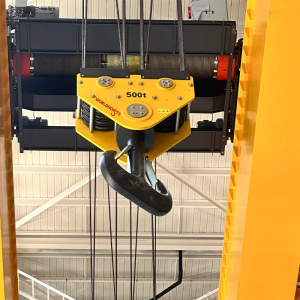
Precision positioning tasks, such as placing a crusher or aligning equipment underground, need finer control than a standard start-stop winch offers. Inching and micro-speed control let the operator move the load in small increments rather than full-speed bursts followed by manual correction.
Check whether the control system supports variable speed at the low end of the range, since this is where positioning accuracy is tested. For sites running multiple winches together, confirm whether the system supports synchronized operation, as mismatched speeds can shift the load unevenly.
5. Braking & Safety Systems
Vertical shaft hoisting and incline pulling both carry fall-back risk if the load isn’t held the moment power is lost, which makes fail-safe braking — a brake that engages automatically on power loss — a requirement rather than an option.
Check that the brake is rated for the maximum load, not just the average working load, since a brake sized only for typical conditions may not hold during a peak-load event. For incline pulling, confirm the brake’s holding torque is rated for the slope itself, as this differs from a level pull.
6. Dust & Moisture Resistance
Underground humidity and open-pit dust expose winch components to conditions beyond typical industrial settings, so enclosure sealing needs to match the specific exposure rather than a generic industrial rating.
Check the rated IP (Ingress Protection) class for the motor housing, control panel, and exposed electrical connections separately, since a single overall rating can mask a weaker seal on one component. Dust resistance and moisture resistance are also rated separately under the IP system, so confirm both figures match the site’s actual conditions rather than assuming a high dust rating also covers sustained moisture exposure.
7. Long-Term Maintenance
Remote or underground sites often have limited access to qualified technicians, making maintainability as important as initial performance specs. Check whether critical components — motor, reducer, brake assembly — use standardized parts that can be sourced locally, rather than proprietary parts requiring manufacturer orders. Confirm routine maintenance needs against the site’s realistic access to technicians.
8. Customization Options
Standard units don’t always fit a mine’s physical layout, making customization a practical consideration. Mounting configuration, hook type, and drum sizing all need to match the site’s existing infrastructure.
Confirm early whether the manufacturer can adjust these elements, since retrofitting a standard unit after purchase is typically more costly than specifying the right configuration upfront. For unusual layout constraints, confirm customization lead times as well.
5 Steps to Match a Winch to Your Mining Operation
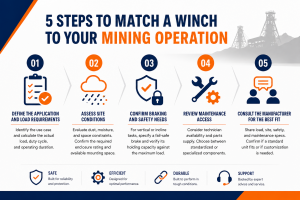
The eight factors above cover what to check. The steps below outline the order to check them in — from defining the task to confirming the final unit with the manufacturer.
Step 1: Define the Application and Load Requirements
Identify the primary use case — hoisting, haulage, or positioning. Then calculate the actual load and duty cycle for that task, including maximum working load, cycle frequency, and cycle duration, rather than relying on a general capacity figure.
Step 2: Assess Site Conditions
Check dust exposure, moisture levels, and space constraints at the specific site where the winch will operate. From these findings, confirm the enclosure rating needed for the environment, and measure available mounting space before narrowing down unit sizes.
Step 3: Confirm Braking and Safety Needs
Determine whether the task involves vertical lifting or incline pulling, since both carry fall-back risk if the load isn’t held when power is lost. If so, specify a fail-safe braking configuration that engages automatically under these conditions, and confirm the brake’s holding capacity against the maximum load the task will place on it.
Step 4: Review Maintenance Access
Assess how often the site can realistically get a technician on-site, and whether spare parts are available locally or need to be ordered from the manufacturer. Based on this, decide between a unit built on standardized parts and one with more specialized components.
Step 5: Consult the Manufacturer for Standard or Custom Fit
Bring the load, site condition, safety, and maintenance specs from Steps 1 through 4 to the manufacturer. With these details in hand, ask them to confirm whether a standard unit meets the requirements, or whether mounting, hook configuration, or drum sizing needs to be customized for the site.
Why WORLDHOISTS Is a Trusted Choice for Mining Winches
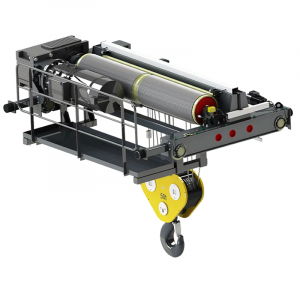
WORLDHOISTS industrial winches are engineered for high-load lifting, pulling, and positioning applications in demanding industrial environments, and are widely used in metallurgy, energy, shipbuilding, mining, and heavy manufacturing industries.
- Engineered for Heavy-Duty Performance: a high-efficiency motor paired with a hardened gearbox handles continuous operation, while an optimized drum design keeps the wire rope winding smoothly and extends rope life.
- Advanced Safety & Control Systems: a dual braking system secures the load, backed by overload protection, emergency stop functions, and an optional VFD for smooth starts and precise positioning.
- Flexible & Customizable Design:a wide range of load capacities and rope configurations can be further tailored with custom drum size, rope length, lifting speed, and control mode, suited to both horizontal pulling and vertical lifting.
- Built for Industrial Environments:a corrosion-resistant steel structure provides industrial-grade protection, with explosion-proof and special environment configurations available where needed.
With these capabilities built in, WORLDHOISTS winches are designed to meet the demands mining operations place on their equipment.
Choosing the Right Winch for Your Operation
Choosing the right mining industrial winch comes down to matching load capacity, duty cycle, safety systems, and environmental protection to your specific operation, then confirming fit through a clear, step-by-step process. WORLDHOISTS builds these requirements into every winch, backed by flexible customization and reliable after-sales support. Contact WORLDHOISTS today to find the right winch solution for your mining operation.